
Wolverhampton Race Results — The Complete Dunstall Park Racing Hub
 Available in US
Every result. Every stall. Every edge.
Understanding Wolverhampton's Racing Data
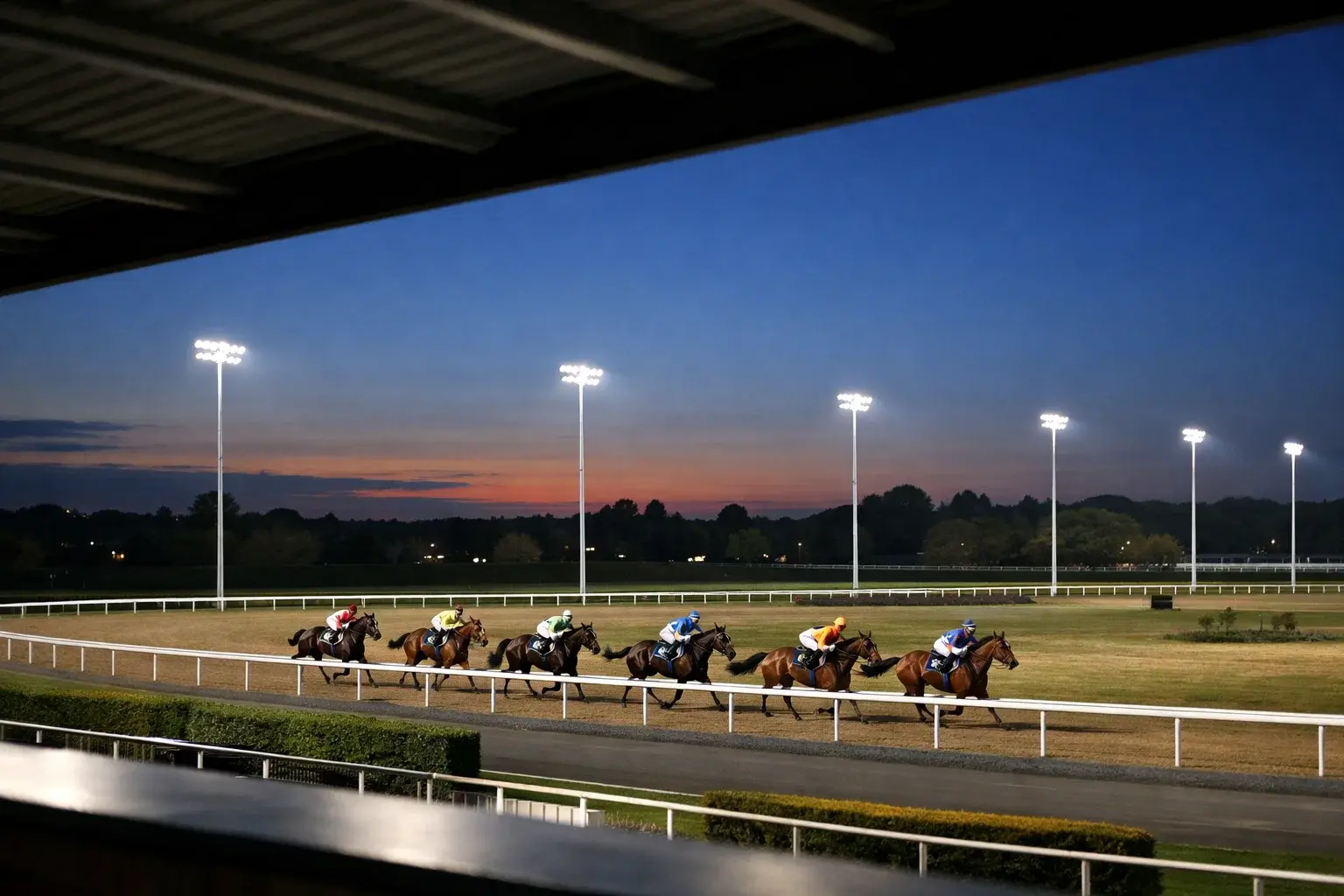
Wolverhampton race results tell a different story to those from any other British racecourse — and that is precisely the point. Dunstall Park stages more than 80 fixtures a year, making it the busiest all-weather venue in the United Kingdom. It is one of three British tracks on Tapeta — alongside Newcastle and Southwell — but the only one combining that surface with a tight, left-handed oval of roughly one mile in circumference and permanent floodlights. That combination of factors — surface, geometry, lighting, volume — produces patterns in the results that reward anyone willing to look beyond the finishing order.
British horseracing drew over 5.031 million racegoers in 2025, surpassing the five-million mark for the first time since 2019, according to the BHA 2025 Racing Report. Wolverhampton contributes a six-figure share of that total across racing, music events and corporate hospitality. The numbers are healthy, yet the racing public's understanding of what actually drives results at Dunstall Park remains surprisingly shallow. Most punters know it exists; far fewer know which stall to want at six furlongs, or why a front-runner at five furlongs has a measurable edge over a hold-up horse, or that the industry as a whole generates an estimated £4.1 billion in annual economic contribution.
This page is built to close that gap. It is not a results feed — you can find the latest finishing positions and starting prices across several dedicated sections of this site. Instead, think of it as an analytical briefing for Wolverhampton: a data-rich reference that covers the course profile, the Tapeta surface and its safety record, draw bias and pace bias broken down by distance, leading trainer and jockey tables with strike rates and profit figures, key races including the Lady Wulfruna Stakes, a comparison with the five other UK all-weather tracks, and practical visitor information. Every result. Every stall. Every edge.
The data powering this hub spans five seasons of all-weather handicap results, supplemented by BHA industry reports, Equine Injury Database safety figures, and the kind of granular stall-by-stall and pace-by-distance numbers that most free-access sites either ignore or lock behind a paywall. Whether you are reviewing last night's card, building a racecard analysis for this evening's meeting, or trying to understand why Wolverhampton form transfers poorly to Lingfield, the sections below are designed to give you the answer — with a number attached.
Wolverhampton in Five Data Points You Should Know Before Betting
- Wolverhampton is the UK's busiest all-weather track (80+ fixtures per year) and the only British course combining Tapeta with a tight left-handed oval and permanent floodlights — a combination that produces unique, measurable patterns in race results.
- Draw bias is strong at sprint distances: Stall 5 at six furlongs returned +65.42 LSP over five seasons, while Stall 9 at seven furlongs lost −287.42 LSP across the same period.
- Front-runners at five furlongs win at 35% in recent handicaps (A/E 1.48); held-up favourites over the same trip lose 51p in every pound staked.
- Rossa Ryan leads jockeys with 145 winners and positive LSP; Charlie Appleby converts 56.41% of his Wolverhampton favourites; the Loughnane father-and-son combination has 32 wins.
- A £10 million venue investment, a new greyhound stadium and Britain's first dual horse-and-greyhound fixture in March 2026 (+43% footfall) signal Dunstall Park's continued growth.
Dunstall Park Course Profile — The Busiest All-Weather Venue in Britain
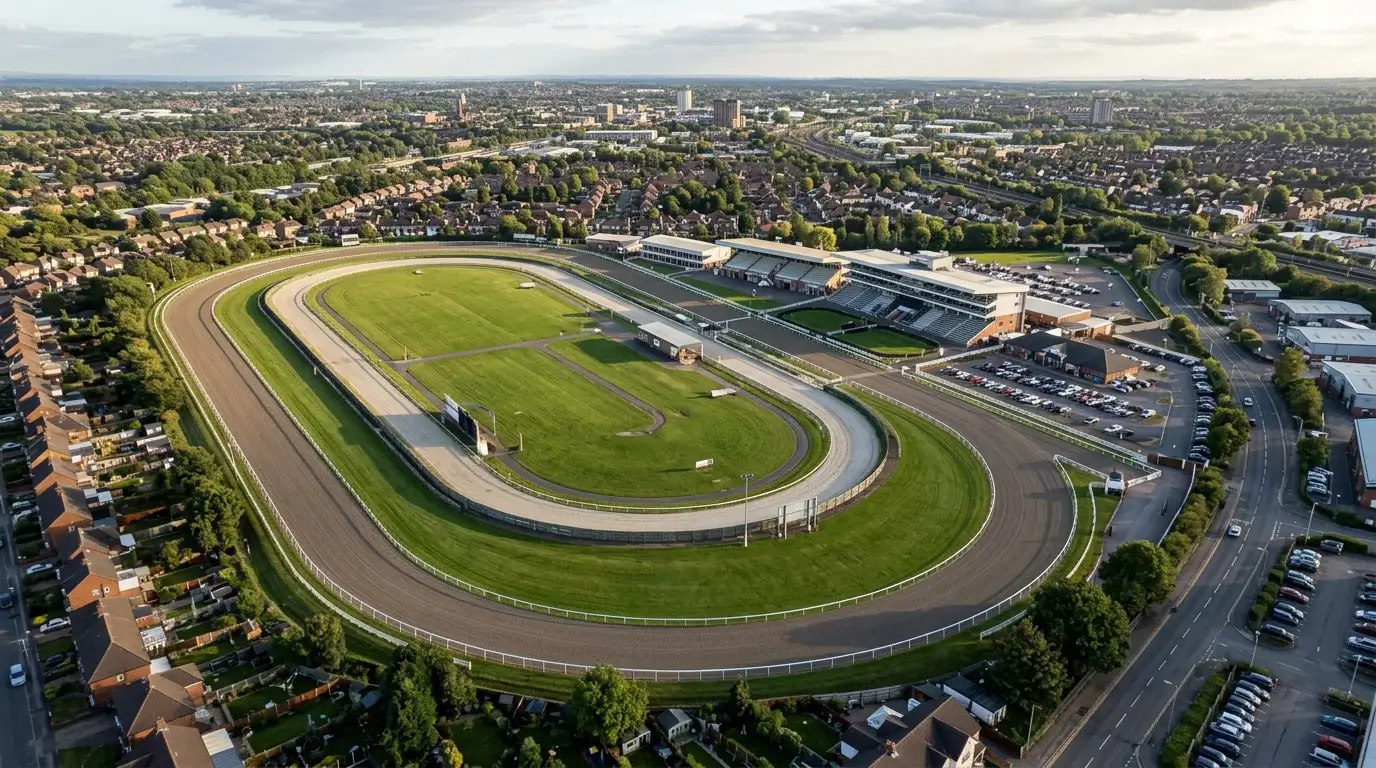
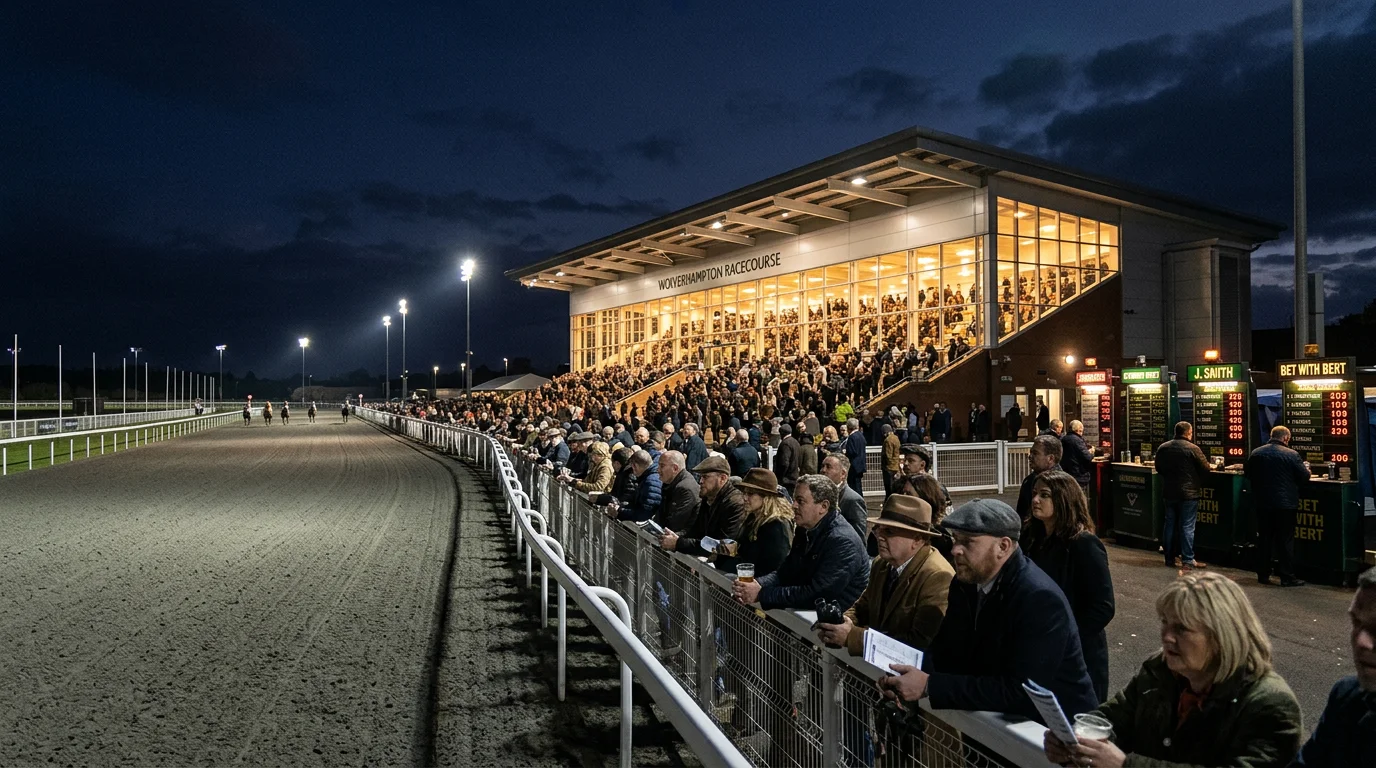
Wolverhampton Racecourse sits on the Dunstall Park estate in the West Midlands, a few minutes north of the city centre. It has been racing there, in one form or another, since the 1880s, though the modern incarnation — purpose-built for all-weather racing under floodlights — dates to December 1993, when the track became the first in Britain to host evening all-weather fixtures. That pioneering status has remained part of Dunstall Park's identity ever since.
The track itself is a left-handed oval with a circumference of approximately one mile. Bends are tight by British standards, which matters enormously for draw bias at sprint distances. The home straight runs for roughly two and a half furlongs, giving front-runners less time to be caught than on more galloping courses. Races are staged over distances from five furlongs to one mile six furlongs, with dedicated starting chutes for the shorter trips and staggered starts for middle-distance events. Understanding where each distance begins relative to the first bend is essential to reading Wolverhampton race results with any depth.
The venue attracts around 120,000 visitors each year, a figure that encompasses racedays, concerts and conferencing. Arena Racing Company, which owns the course, completed a £10 million investment programme in 2025, modernising hospitality areas, upgrading facilities across the site, and — most dramatically — constructing a greyhound track inside the horse-racing oval.
"This investment allows us to offer even more flexibility for event organisers — whether they're planning a conference, trade show, festival or hospitality," said David Ideson, Executive Director of Wolverhampton Racecourse. "We're proud to be evolving into a true destination for both corporate and consumer events in the region."
The Dunstall Park Greyhound Stadium opened on 19 September 2025 — the first new greyhound venue in Britain since Towcester in 2014. It was built within the existing horse-racing circuit, sharing the grandstand and facilities with raceday visitors. The concept was designed to create dual-fixture events, combining horse racing and greyhound racing on the same day at the same venue.
That concept became reality on 7 March 2026, when Wolverhampton hosted the first-ever dual horse-and-greyhound fixture in British sporting history. Footfall rose by 43% compared with the equivalent Saturday twelve months earlier, a number that suggests the public appetite for the format is genuine. David Ideson described the day as "a real highlight in our 138-year history of hosting racing at Dunstall Park."
From a punter's perspective, the dual-fixture development is interesting for one specific reason: bigger crowds generate stronger on-course betting markets, which in turn produce more accurate starting prices. For a track that runs predominantly evening meetings — often with modest attendances — anything that increases the volume of money through the ring is a net positive for SP reliability. Whether the dual format becomes a regular fixture or remains a seasonal experiment will be worth watching through the rest of 2026.
Track Direction
Left-handed oval, approximately one mile circumference
Surface
Tapeta (installed 2014)
Distances
5f to 1m 6f
Lighting
Permanent floodlights — evening and twilight meetings year-round
Annual Fixtures
80+ (most of any UK all-weather track)
Annual Visitors
Approximately 120,000
Ownership
Arena Racing Company (ARC)
Tapeta Edge Analyzer
The Tapeta Surface — From Fibresand to Synthetic Consistency
The surface beneath the hooves at Wolverhampton has changed three times since the track opened for all-weather racing in 1993, and each transition reshaped the form book. Understanding that timeline is not trivia — it is the foundation for interpreting any Wolverhampton race result that predates the current configuration.
When Dunstall Park launched as Britain's first floodlit all-weather track, it ran on Fibresand: a sand-based material mixed with synthetic fibres, designed for drainage but criticised for inconsistency and abrasiveness. Fibresand served the track for eleven years before being replaced in 2004 by Polytrack, a wax-coated blend of polypropylene fibres, recycled rubber and silica sand. Polytrack was a significant upgrade — more consistent going, better shock absorption, improved drainage — and it became the dominant all-weather surface across British racing. Lingfield, Kempton and Chelmsford all adopted variants of it.
Wolverhampton broke ranks in 2014 by becoming the first racecourse in the United Kingdom to install Tapeta. The surface, developed by Michael Dickinson — the former trainer who famously saddled the first five home in the 1983 Cheltenham Gold Cup — is a proprietary blend of wax-coated silica sand, synthetic fibres and recycled rubber crumb. It differs from Polytrack principally in its wax formulation and fibre structure, producing a surface that its manufacturer claims is more uniform, less prone to kickback, and kinder to equine limbs.
Safety data supports at least part of that claim. According to the US Jockey Club Equine Injury Database, the fatality rate on synthetic surfaces in 2022 was 0.41 per 1,000 starts — roughly 3.5 times lower than on dirt (1.44) and 2.4 times lower than on turf (0.99). The 2023 figures showed an increase to 0.97 per 1,000 on synthetics, though the rate remained the lowest of any surface category. Research by Dr. Pratt of Tapeta Footings found that horses experience approximately 50% less concussive impact on Tapeta compared with other racing surfaces, a finding that has contributed to growing international interest in the material.
"The data shows that since 2009, the risk of fatal injury during racing has declined by 37.5%, which is statistically significant," noted Professor Tim Parkin of the University of Bristol, whose analysis underpins much of the Equine Injury Database reporting. While that decline encompasses improvements across all surface types and is not attributable solely to synthetics, the gap between synthetic fatality rates and those on traditional surfaces is persistent and measurable.
For bettors, the practical implications of Tapeta are specific. The surface produces a more consistent going description — almost always recorded as "standard" or "standard to slow" — which reduces one variable from the form equation. Horses that act on Tapeta tend to produce reliable speed figures from run to run, making pace analysis more predictive than on turf, where ground conditions shift between declarations and post time. The trade-off is that form earned on Tapeta does not always translate to Polytrack tracks (Lingfield, Kempton, Chelmsford) or to the Tapeta installations at Newcastle and Southwell, which were laid later and reportedly ride slightly differently. Cross-surface transfers remain one of the trickier aspects of all-weather form analysis, and the deeper detail on that subject sits within the dedicated Tapeta surface analysis on this site.

Key Races — Lady Wulfruna, All-Weather Championships and Beyond
Wolverhampton is not a Group-race track. It does not host a Classic trial, a Royal Ascot feeder or a championship-level event on turf. What it does host — consistently, week after week — is a volume of competitive all-weather racing that feeds directly into the most important series in British synthetic-surface racing.
The marquee event at Dunstall Park is the Lady Wulfruna Stakes, a Listed race over seven furlongs and 36 yards with a prize fund of £60,000 in 2026. The race reaches its 25th running this spring — a milestone that underlines how firmly Wolverhampton has established itself in the all-weather calendar. The distance, seven furlongs plus that extra 36 yards, is unique to Dunstall Park and produces its own peculiarities around draw bias and pace, which are explored in the draw and pace sections further down this page. The Lady Wulfruna typically attracts a field of proven all-weather performers, several of whom will have accumulated qualifying points for the season's culminating event.
That culminating event is the All-Weather Championships Finals Day, held on Good Friday at a designated host track. The championship series spans more than 200 qualifying fixtures across six British all-weather courses — Chelmsford City, Kempton Park, Lingfield Park, Newcastle, Southwell and Wolverhampton — with a total prize fund of £1 million on Finals Day itself. Wolverhampton, as the busiest of those six venues, contributes a disproportionate share of qualifying races, making its results essential reading for anyone following the championship standings through the winter and spring of 2026.
Beyond the headline events, Wolverhampton's bread-and-butter programme is dominated by handicaps across Classes 2 to 6, maiden and novice races, and evening cards that can include six or seven contests in a single meeting. These cards are the backbone of British all-weather betting turnover — less glamorous than Ascot or York, certainly, but generating a reliable flow of competitive, analysable racing. The evening schedule is particularly relevant: floodlit meetings at Dunstall Park often attract different jockey bookings and field compositions compared with daytime fixtures, a pattern worth tracking for regular punters.
The Lady Wulfruna's seven-furlong distance and the All-Weather Championships pathway both connect directly to one of Wolverhampton's most distinctive analytical features — the measurable bias created by stall position at different distances.
Draw Bias at Wolverhampton — Why Stall Position Matters
Draw bias at Wolverhampton is not a rumour or a casual observation — it is a statistically measurable phenomenon that shifts profit and loss by hundreds of pounds depending on distance and stall number. The track's geometry is the root cause. The tight left-handed bends, combined with the position of starting chutes for sprint distances, mean that horses drawn low (towards the inside rail) have a shorter path to the first turn. At five and six furlongs, that advantage is acute. At a mile and beyond, it diminishes as the start moves closer to the bend and runners have more time to settle into position.
Three metrics capture draw bias most effectively. Win percentage shows which stalls win most often; it is useful but vulnerable to sample-size distortion. Actual versus Expected (A/E) ratio compares a stall's observed wins against the number predicted by starting prices — a value above 1.00 means the stall outperforms the market, below 1.00 means it underperforms. Level-Stakes Profit (LSP) is the sharpest tool: it shows the profit or loss from a £1 win bet on every runner from a given stall over a defined period. A stall with positive LSP over five seasons is not just winning often — it is beating the odds.
The extremes are striking. Data from OLBG, compiled via HorseRaceBase across the 2021–2025 seasons, shows that Stall 5 at six furlongs returned a Level-Stakes Profit of +65.42 — a figure that represents genuine, exploitable value over a meaningful sample. At seven furlongs, the picture flips: Stall 9 produced an LSP of −287.42 across the same period, an almost comically bad position to be drawn in. Those are not marginal differences. They are the kind of numbers that should be factored into any racecard analysis before a single form line is read.
The table below summarises the direction and strength of draw bias by distance at Wolverhampton. It is a high-level guide; the full stall-by-stall breakdowns with win rates, A/E and LSP sit in the dedicated draw bias analysis elsewhere on this site.
| Distance | Favoured Stalls | Bias Strength | Key Factor |
|---|---|---|---|
| 5f | Low (1–4) | Strong | Tight bend from sprint chute; low draw saves ground |
| 6f | Low–Middle (3–6) | Moderate–Strong | Similar geometry to 5f but marginally more run-up |
| 7f | Low (1–4) | Moderate | Start near the bend; high draws lose position early |
| 1m | Slight low preference | Weak | Start on the bend; more time to reposition |
| 1m 1f+ | Negligible | Very weak | Distance dilutes stall advantage |
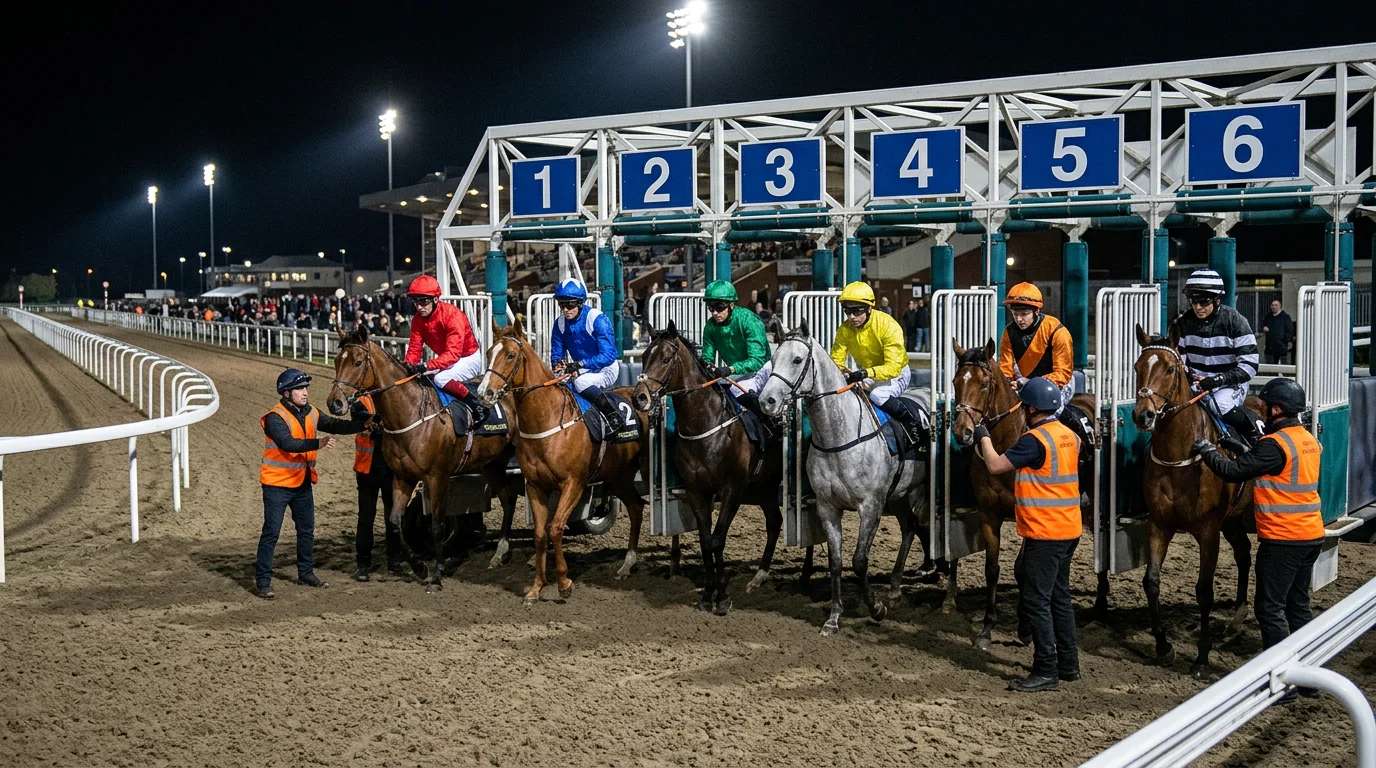
Field size amplifies everything. In races with ten or more runners at sprint distances, the bias is at its most pronounced — horses drawn wide have more traffic to navigate and more ground to cover on the turn. In small fields of six or fewer, the bias weakens because there is less congestion and riders have room to manoeuvre regardless of starting position. This interaction between stall number and field size is arguably the single most useful piece of information a bettor can carry into a Wolverhampton sprint handicap.
Pace Bias — Front-Runners vs Hold-Up Horses
Draw bias tells you where to start. Pace bias tells you how to run. At Wolverhampton, the two are deeply connected — and both favour aggression at the shorter distances.
The data from Sandracer.com, covering six seasons of all-weather handicap results, paints a clear picture at five furlongs. Front-runners at this distance show a 35% recent win rate (long-term average: 20%), with an Actual versus Expected ratio of 1.48 and a profit of 70p in the pound on level stakes. Those are remarkable numbers. An A/E of 1.48 means front-runners are winning almost 50% more often than their starting prices imply they should — the market consistently underestimates the advantage of making the running at five furlongs on this tight, left-handed track.
The flipside is equally instructive. According to analysis by Dave Renham on Geegeez.co.uk, held-up favourites at five furlongs returned a loss of 51 pence in the pound — meaning that if you backed every market leader ridden from behind over this trip, you would have lost more than half your stake money. Front-running favourites over the same distance, by contrast, showed a profit of 22p in the pound. The gap between those two figures is enormous and it is driven by the track's geometry: a short run from the stalls to the first bend, a tight turn that rewards rail position, and a straight of only two and a half furlongs that offers hold-up horses too little ground to overhaul a leader who has kicked clear.
The pattern extends to six furlongs, where front-runners have returned a profit of £117.80 to a £1 level stake since 2017, according to Sandracer.com — a smaller edge than at five furlongs but still a meaningful one over a large sample. At seven furlongs, the bias shifts. Held-up favourites at this trip lose 43p in the pound, a substantial figure that suggests the market overestimates the chances of late closers even over a longer trip. The explanation is partly topographical — the seven-furlong start is positioned close to a bend, meaning prominent racers still have a positional edge — and partly behavioural, since jockeys at Wolverhampton tend to ride more aggressively in the knowledge that the track rewards forwardness.
At a mile and beyond, the bias softens. Pace still matters — it always does — but the advantage enjoyed by front-runners diminishes as distances increase, fields stretch out, and the geometry of the course has less influence on the final outcome. The full pace-bias breakdown by distance, including P&L figures for each running style, is available in the dedicated pace analysis section of this site.
At Wolverhampton sprints, the combination of a low draw and a front-running style is the single most statistically profitable angle in British all-weather racing. Any racecard analysis that ignores pace bias at this track is working with incomplete information.
Top Trainers and Jockeys at Wolverhampton
Trainer and jockey statistics at Wolverhampton reveal patterns that the form book alone cannot show. A trainer's strike rate at a specific track, over a meaningful sample, tells you something about their familiarity with the surface, their booking choices, and the type of horse they target at that venue. The same applies to jockeys, for whom course knowledge on a tight, left-handed all-weather track is a genuine skill rather than a marketing phrase.
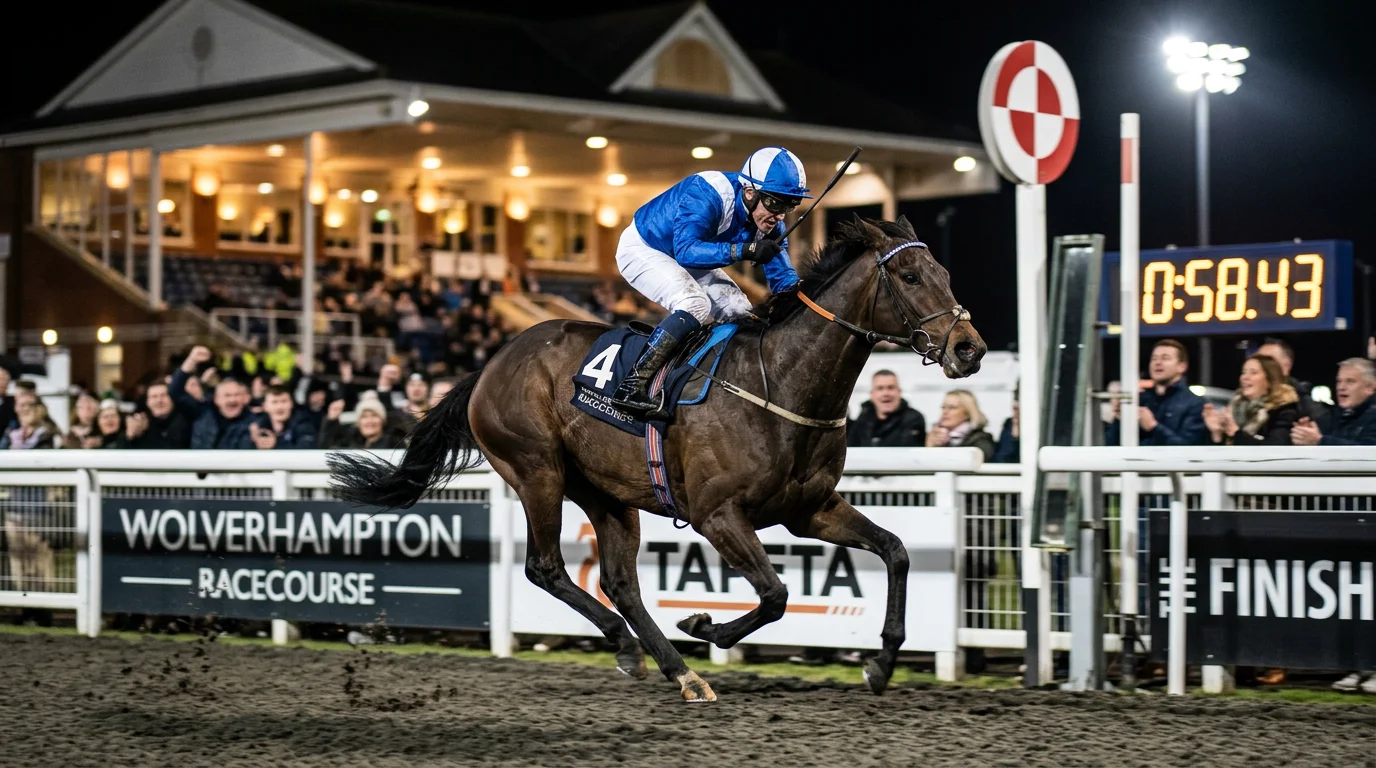
The leading jockey at Wolverhampton across the 2021–2025 period is Rossa Ryan, with 145 winners and a Level-Stakes Profit of +63.95, according to data compiled by OLBG via HorseRaceBase. A positive LSP over five seasons from a rider with that volume of winners is a significant marker. It means that blindly backing every Ryan mount at Dunstall Park would have produced a profit — something very few jockeys at any track can claim over a dataset of that size. Ryan's effectiveness here is partly a function of opportunity (he rides for several powerful yards that target Wolverhampton regularly) and partly a function of tactical nous on a course that rewards decisive front-end riding.
Among trainers, the most eye-catching statistic belongs to Charlie Appleby, whose runners at Wolverhampton include 22 winners from 39 runners when sent off as favourite — a strike rate of 56.41%, with an A/E of 1.12 and 34 of those 39 finishing in the first three (87.18% placed). Appleby is primarily a Newmarket-based operation with a global reach, and the decision to send a runner to Wolverhampton from that base usually signals intent. When an Appleby-trained favourite lines up at Dunstall Park, the data says it wins more often than the market expects.
The most productive trainer-jockey combination over recent seasons is the father-and-son partnership of Daniel Mark Loughnane and Billy Loughnane, who have combined for 32 winners at Wolverhampton. The Loughnane yard is based locally, giving them both a logistical advantage and an intimate understanding of how the track rides from week to week. Billy Loughnane's career trajectory — from apprentice to one of the most sought-after young riders in British flat racing — was built in part on the back of regular Wolverhampton winners.
| Category | Name | Key Stat | Period |
|---|---|---|---|
| Top Jockey (by LSP) | Rossa Ryan | 145 wins, LSP +63.95 | 2021–2025 |
| Top Trainer (favs SR) | Charlie Appleby | 56.41% SR with favourites | 2021–2025 |
| Top Combo | D.M. Loughnane / B. Loughnane | 32 wins | 2021–2025 |
Full leaderboards covering the wider pool of trainers and jockeys — including seasonal trends, class-level breakdowns and A/E values — are available in the dedicated trainer and jockey statistics section. The data there goes beyond the top three to include every handler and rider with a statistically meaningful record at the track.
Course Specialists — Horses Who Thrive at Dunstall Park
Every racecourse has its specialists — horses whose form at a particular track outstrips their performances elsewhere. At Wolverhampton, course-and-distance records carry extra weight because the Tapeta surface and the tight left-handed configuration create a specific set of demands. A horse that handles both is not merely a course winner; it is a repeat-profit opportunity.
Course specialists at Dunstall Park tend to share certain traits: they act on the surface (obvious but essential), they handle the bends without losing momentum, and they often have a tactical preference — usually prominent running — that aligns with the track's bias. Some build their entire racing career around Wolverhampton, turning up under floodlights every few weeks and delivering a level of consistency that their official ratings alone would not predict.
The most celebrated outlier in Wolverhampton history is Dandy Flame, who won at the track in 2016 at odds of 200/1 — the longest-priced winner ever recorded at Dunstall Park. That kind of result is a statistical anomaly, not a replicable angle, but it illustrates the volatility that all-weather handicaps can produce and the danger of dismissing any runner in a large-field sprint.
Dandy Flame's 200/1 victory at Wolverhampton in 2016 remains the longest-priced winner in the history of Dunstall Park — a reminder that all-weather handicaps, particularly sprints with large fields, are capable of producing extraordinary results.
The more useful data sits in the repeat-winner category: horses that have won three or more times at the course over a rolling period. These animals often represent value when returning to Wolverhampton after a run at a different all-weather venue, where their form may appear to have dipped simply because the track did not suit. The full list of active course specialists, updated by season, is maintained in the course specialists section of this site.
Wolverhampton Among the UK All-Weather Tracks
Britain has six all-weather racecourses: Chelmsford City, Kempton Park, Lingfield Park, Newcastle, Southwell and Wolverhampton. They share a season (broadly October through April, though many race year-round) and a function (providing racing when turf tracks are unfit), but they differ in almost every respect that matters to a bettor — surface type, track geometry, field sizes and race programme.
Wolverhampton's position in that group is distinctive. It is one of three UK tracks now running on Tapeta — alongside Newcastle and Southwell — but the only one pairing the surface with permanent floodlights on a tight left-handed oval, the only left-handed all-weather course with bends tight enough to create measurable sprint draw bias, and the busiest venue by fixture count. Lingfield (Polytrack, right-handed, sharp undulations) and Kempton (Polytrack, right-handed, flat triangular circuit) are probably the two courses most often compared with Wolverhampton, yet form transfers between any of these venues are unreliable without accounting for surface and configuration differences.
British horseracing sustains roughly 85,000 jobs and underpins a substantial slice of the rural economy, according to BHA data submitted to the House of Commons Library. The all-weather circuit accounts for a growing share of that total: in January and February 2024, 73% of all-weather flat races attracted fields of eight or more runners — the highest proportion since 2007, according to the BHA's February 2024 Racing Report. The full track-by-track comparison — covering surface types, circumference, straight length, average field size, and distinguishing characteristics for each of the six courses — is available in the dedicated all-weather comparison article on this site.
Visiting Wolverhampton Racecourse — The Essentials
Dunstall Park sits just north of Wolverhampton city centre, accessible from the M54 (junction 1) and within walking distance of Wolverhampton railway station for those travelling by train. The course provides 1,500 free parking spaces on site — a generous allocation by British racecourse standards, and one that means arriving by car rarely involves the overflow-field frustration common at turf courses during festival meetings.
Evening meetings are the norm at Wolverhampton, thanks to the permanent floodlighting that has been part of the venue since 1993. The atmosphere under lights is noticeably different from a daytime card — smaller but more committed crowds, a sharper focus on the betting, and a schedule that suits anyone who cannot take a midweek afternoon away from work. First races typically go off between 4.30pm and 6.00pm on evening cards, with the last race usually around 8.30pm.
The £10 million ARC investment completed in 2025 upgraded several public and hospitality areas, and the addition of the greyhound stadium has expanded the range of events available. Raceday admission prices, dress code guidance, hospitality packages and full transport directions are covered in the comprehensive visitor guide elsewhere on this site. For first-time visitors, the key practical point is this: Wolverhampton is a compact, navigable venue that does not require the logistical planning of a Cheltenham or an Aintree. Turn up, park, walk in, and you are trackside within minutes.
Frequently Asked Questions About Wolverhampton Racing
What surface does Wolverhampton Racecourse use?
Wolverhampton runs on Tapeta, a synthetic surface made from wax-coated silica sand, synthetic fibres and recycled rubber. It was installed in 2014, replacing Polytrack, and Wolverhampton was the first British racecourse to adopt it. The surface produces consistent going — typically described as "standard" or "standard to slow" — and safety data from the Equine Injury Database shows lower fatality rates on synthetics than on turf or dirt.
How does Tapeta affect horse performance?
Tapeta generally favours horses with consistent, reliable speed figures rather than those reliant on specific ground conditions. Research indicates roughly 50% less concussive impact compared with other surfaces, which can benefit horses with joint issues. As Irwin Driedger, Director of Thoroughbred Racing at Woodbine, observed: "The new Tapeta seemed very fair and kind and that is what I liked about it. I am not a big fan of biases that sometimes play a big part in races." Form earned on Tapeta does not always transfer reliably to Polytrack or turf courses.
Is there a draw bias at Wolverhampton?
Yes, and it is one of the strongest in British all-weather racing. At five and six furlongs, low draws (stalls 1–5) have a measurable advantage due to the tight left-handed bend near the sprint starts. Over five seasons, Stall 5 at six furlongs showed an LSP of +65.42, while Stall 9 at seven furlongs returned −287.42. The bias weakens significantly at a mile and beyond. Full stall-by-stall data is available in the draw bias analysis section.
What are the main races at Wolverhampton?
The flagship event is the Lady Wulfruna Stakes, a Listed race over 7f 36y with a prize fund of £60,000 in 2026, marking its 25th running. Wolverhampton also hosts numerous All-Weather Championships qualifying races throughout the season, contributing to the series' £1 million Finals Day on Good Friday. The regular programme is dominated by handicaps, novice and maiden races across evening and afternoon cards.
Who are the top jockeys and trainers at Wolverhampton?
Over the 2021–2025 period, Rossa Ryan leads the jockey table with 145 winners and an LSP of +63.95. Among trainers, Charlie Appleby stands out with a 56.41% strike rate when running favourites. The most productive trainer-jockey partnership is Daniel Mark Loughnane and Billy Loughnane with 32 combined winners. Detailed leaderboards are available in the trainer and jockey statistics section.
Do front-runners have an advantage at Wolverhampton?
At sprint distances, the advantage is significant. Front-runners at five furlongs show a 35% win rate in recent handicaps with an A/E of 1.48, while held-up favourites over the same trip lose 51p in the pound. The track's short straight and tight bends make it difficult for hold-up horses to close the gap. At a mile and beyond, the front-runner edge narrows considerably.
How do I get to Wolverhampton Racecourse?
Dunstall Park is accessible from junction 1 of the M54 and sits within walking distance of Wolverhampton railway station. The course offers 1,500 free parking spaces on site. Evening meetings typically have first races between 4.30pm and 6.00pm, with the last race around 8.30pm. The full visitor guide covers transport, admission, dress code and hospitality options.
What is the All-Weather Championships series?
The All-Weather Championships is a season-long series spanning more than 200 qualifying fixtures across six British all-weather racecourses. Horses accumulate points through the winter and spring, with the top qualifiers contesting Finals Day — a £1 million raceday held on Good Friday. Wolverhampton contributes more qualifying races than any other venue due to its schedule of 80+ annual fixtures.
Can Wolverhampton form be used at other all-weather tracks?
With caution. Wolverhampton's Tapeta surface rides differently from the Polytrack used at Lingfield, Kempton and Chelmsford, and from the Tapeta installations at Newcastle and Southwell, which were laid at different times and reportedly ride with subtle differences. Horses transferring between surfaces may not replicate their Dunstall Park form, particularly those whose success relies on front-running tactics over sprint distances — a style that Wolverhampton's track geometry rewards more generously than most. Cross-surface form analysis requires adjustments for surface type, track direction and configuration.
When does Wolverhampton race?
Wolverhampton races year-round, with its heaviest schedule between October and April when all-weather fixtures dominate the British calendar. The majority of meetings are held in the evening under floodlights, though afternoon cards are also scheduled. In the 2025–2026 season, the track stages more than 80 fixtures. The complete fixture list, including evening cards and feature racedays, is available in the fixtures and calendar section.
Data Sources and Methodology
The statistics, tables and analysis presented across this site draw on several primary data sources. Draw bias and stall-specific data (win percentages, A/E ratios, Level-Stakes Profit) are compiled from OLBG, which aggregates results via HorseRaceBase, covering handicap races from the 2021–2025 flat seasons. Pace bias figures and running-style profit-and-loss data are sourced from Sandracer.com and Geegeez.co.uk, with sample periods noted in each section. Trainer and jockey statistics are drawn from OLBG and On Course Profits.
Industry-level data — attendance figures, betting turnover, horses in training, economic contribution — is sourced from the British Horseracing Authority's 2025 Racing Report and from the Horserace Betting Levy Board Annual Report 2024/25. Safety data references the US Jockey Club Equine Injury Database as reported by the Thoroughbred Horsemen's Association.
All data is presented for informational and analytical purposes. Past performance does not guarantee future results. Statistical edges can narrow or disappear as markets adjust. Readers should treat the figures here as one input among many when forming their own assessments — not as betting advice.
