
Horse Racing Safety on Synthetic Tracks — EID Data and Tapeta
 Available in US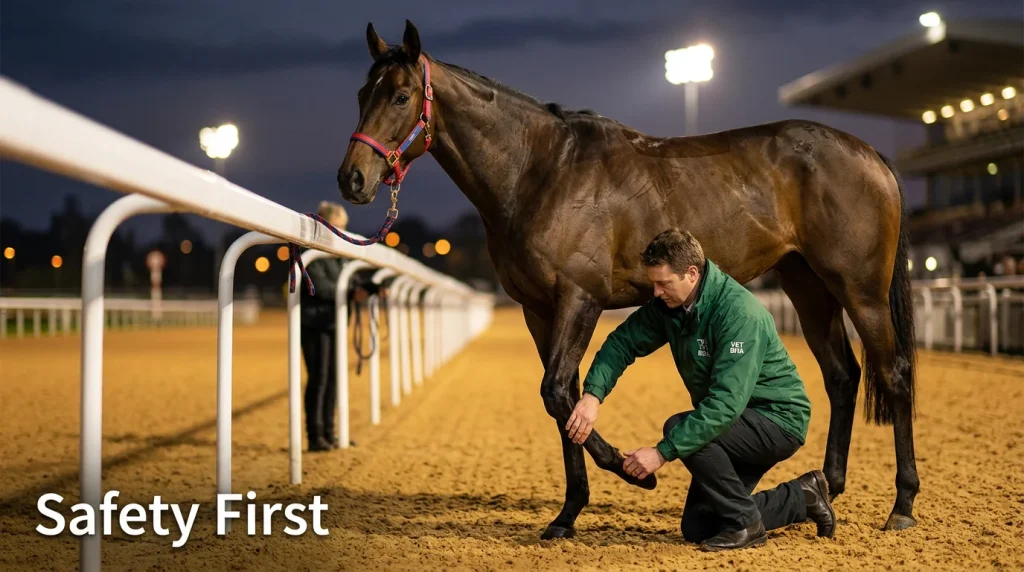
Horse racing safety on synthetic tracks is supported by a growing body of evidence that places artificial surfaces — Tapeta, Polytrack and Fibresand — ahead of both turf and dirt on the key welfare metric that matters most: the rate of fatal injuries during racing. The Equine Injury Database, maintained by the US Jockey Club, provides the most comprehensive dataset available, and its findings are unambiguous. Synthetic surfaces produce fewer catastrophic injuries per thousand starts than any other surface type.
For anyone who follows racing at Wolverhampton — a track that has raced on Tapeta since 2014 — the safety data is relevant in two ways. First, it speaks to the welfare of the horses whose form you study and whose performances you back. Second, it explains a significant part of the global trend toward synthetic surface adoption, a trend that is reshaping racing calendars from Britain to North America and beyond. This page presents the data, examines Tapeta’s specific safety profile, and charts the worldwide expansion that the evidence is driving.
The Equine Injury Database — Surface by Surface
The Equine Injury Database (EID) is maintained by The Jockey Club in the United States and tracks fatality rates across all surface types at US racetracks. It is the most extensive dataset of its kind in the world, covering hundreds of thousands of race starts annually, and it provides the statistical foundation for virtually every policy discussion about racing surface safety.
In 2022, the EID recorded a fatality rate on synthetic surfaces of 0.41 per 1,000 starts. On turf, the rate was 0.99. On dirt — the dominant surface in American racing — the rate was 1.44. The numbers are stark: synthetic surfaces were 3.5 times safer than dirt and 2.4 times safer than turf on the headline fatality metric. That year represented the low point for synthetic-surface fatalities in the database’s history, according to data published via the Thoroughbred Horsemen’s Association.
The 2023 data showed a rise in synthetic fatalities to 0.97 per 1,000 starts — more than double the 2022 figure. However, even at that elevated rate, synthetic surfaces remained the safest category. Dirt fell marginally to 1.43, and turf rose to 1.13. The year-on-year fluctuation on synthetics is partly attributable to the smaller sample size: fewer races are run on synthetic surfaces than on dirt or turf in the US, so individual incidents have a larger proportional impact on the rate. The multi-year trend, rather than any single year’s figure, is the more reliable indicator — and across the full span of the database, synthetic surfaces have consistently produced the lowest fatality rates.
Professor Tim Parkin of the University of Bristol, who has analysed EID data extensively, summarised the broader trajectory in 2023: since 2009, the risk of fatal injury during racing has declined by 37.5%, a reduction he described as statistically significant. That decline encompasses all surface types but has been most pronounced on synthetic tracks, where the engineered consistency of the footing removes many of the variables — ruts, hard spots, waterlogging — that contribute to catastrophic injuries on natural surfaces.
The EID data is American, but its relevance to British all-weather racing is direct. Tapeta, Polytrack and Fibresand are the same materials used at tracks in the US dataset. The mechanical properties that make synthetic surfaces safer — shock absorption, drainage, uniformity — operate identically whether the track is in Kentucky or the West Midlands. British-specific injury data, compiled by the BHA, broadly confirms the same pattern: all-weather racing in Britain is safer than turf racing, and the gap has widened over time as surfaces have improved.
Tapeta’s Safety Profile
Within the synthetic category, Tapeta has accumulated the strongest safety evidence of any individual surface product. The most striking data point comes from Gulfstream Park in Florida, where Tapeta was installed alongside the existing dirt track. Between 2022 and 2023, Gulfstream recorded just one fatality in 7,085 starts on its Tapeta surface — a rate of 0.14 per 1,000, or roughly one fatal incident for every seven thousand races. That is 9.7 times safer than the dirt track at the same venue over the same period, as documented by the Paulick Report.
The physical properties of Tapeta help explain the numbers. Research by Dr. Pratt of Tapeta Footings found that horses on Tapeta experience approximately 50% less concussion impact compared with other surfaces. Concussion — the shock transmitted through the limbs at each stride — is a primary contributor to musculoskeletal injuries in racehorses. A surface that halves the impact load on every stride is, in engineering terms, a surface that dramatically reduces the cumulative stress on the horse’s body over the course of a race.
Tapeta’s composition — wax-coated sand, synthetic fibres and recycled rubber — is designed to maintain consistent cushioning regardless of weather or traffic. Unlike dirt, which can bake hard in summer and freeze in winter, or turf, which degrades during a meeting and changes character after rain, Tapeta delivers the same footing from the first race of the day to the last. That consistency matters for safety because it eliminates the surface surprises — a hard patch, a soft spot, a sudden change in grip — that can cause a horse to misstep at speed.
At Wolverhampton specifically, the Tapeta surface has been in place for over a decade, and the track’s safety record reflects the broader trends in the EID data. The course’s tight bends might raise safety concerns in theory — tighter turns can produce more stress on limbs — but in practice the combination of Tapeta’s cushioning and the relatively slow speeds through the bends appears to offset the geometric risk. The data does not suggest that Wolverhampton’s tight oval is any less safe than wider synthetic tracks elsewhere.
Global Tapeta Expansion
The safety evidence is driving a worldwide expansion of synthetic surfaces, with Tapeta at the leading edge. The most significant recent development is NYRA’s decision to surface Belmont Park with Tapeta for all winter racing from 2026. Dave O’Rourke, NYRA’s president and CEO, stated that the relevant data unequivocally supports a shift to all-weather surfaces during the winter months — language that reflects a policy decision driven by evidence rather than tradition.
Lisa Lazarus, CEO of the Horseracing Integrity and Safety Authority (HISA), publicly commended NYRA for prioritising horse safety through the Tapeta adoption. HISA’s endorsement is significant because the organisation sets safety standards across all US racing jurisdictions, and its support for synthetic surfaces signals a regulatory direction that other tracks are likely to follow.
Beyond Belmont, Tapeta is already in use at Woodbine in Canada, Golden Gate Fields in California, and a growing number of tracks internationally. Each new installation adds to the body of performance and safety data, which in turn strengthens the case for further adoption. The feedback loop is self-reinforcing: more tracks install Tapeta, more data is generated, the safety case becomes stronger, and more tracks install Tapeta.
For Wolverhampton, the global expansion validates a decision the course made in 2014 when it became the first British track to install the surface. A decade later, the rest of the world is catching up. Wolverhampton’s data — its form lines, its draw-bias patterns, its safety record — contributes to the international evidence base, and the course’s position as the busiest Tapeta track outside North America gives it a unique role in the global picture.
The welfare case for synthetic surfaces is not a peripheral concern. It is central to the future of the sport. Racing’s social licence — its ability to operate with public support in an era of heightened animal-welfare scrutiny — depends on demonstrating that the sport takes horse safety seriously. The EID data, the Gulfstream figures, the Tapeta concussion research and the global adoption trend all point in the same direction: synthetic surfaces save lives, and the evidence is no longer debatable. What remains to be decided is how quickly the rest of the sport acts on it.
Horse Racing Safety on Synthetic Tracks — More on this topic at wolverhampton race results.
See also News.
