
Wolverhampton Draw Bias by Distance — Stall Stats and Data
 Available in US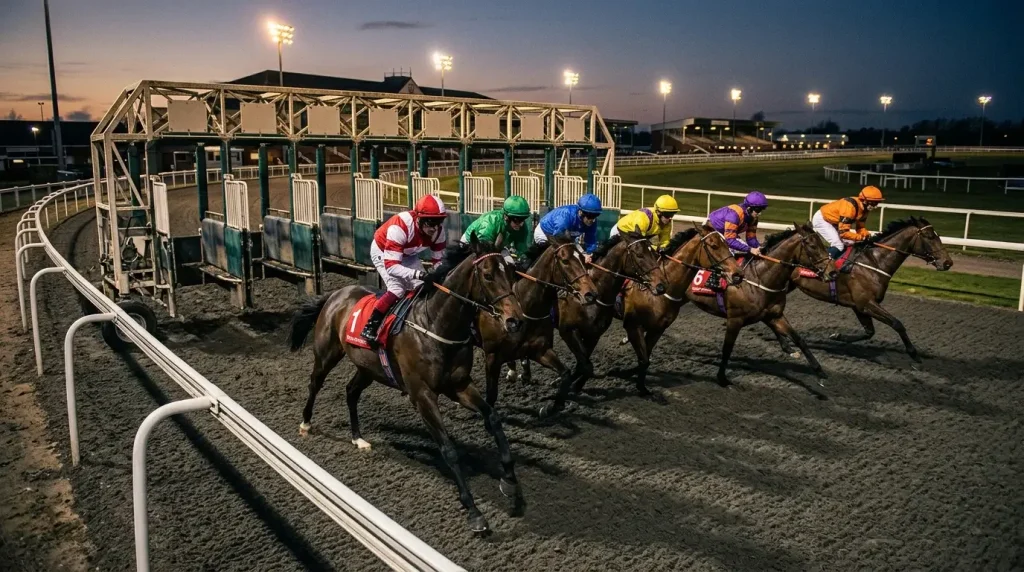
Where You Start Changes Where You Finish
Wolverhampton draw bias is not a rumour passed around betting forums — it is a measurable, season-after-season distortion that separates this track from almost every other all-weather venue in Britain. The tight left-handed oval at Dunstall Park, barely a mile in circumference, funnels sprinters through a sharp bend within seconds of leaving the stalls. The geometry alone would be enough to create a positional advantage. Combine it with the Tapeta surface, which rewards horses that find a rhythm early, and you have a course where stall allocation is a genuine form factor rather than a footnote on the racecard.
This article presents five seasons of handicap data — 2021 through 2026 — covering every distance from five furlongs to a mile and four furlongs. The metrics are standard but revealing: win percentage by stall, level-stakes profit and loss (LSP), and the actual-versus-expected ratio (A/E) that strips out market bias. Where a stall wins more often than the odds imply it should, the A/E climbs above 1.00. Where the market overestimates a stall’s chances, it sinks below. The numbers are drawn from OLBG’s HorseRaceBase dataset, cross-referenced against pace figures from Sandracer and running-style breakdowns from Geegeez.
The core finding is straightforward. At sprint distances — five and six furlongs — low-drawn horses enjoy a structural advantage that translates into real profit at starting price. At seven furlongs, the picture inverts in surprising ways. At a mile and beyond, draw bias fades but does not vanish. Each distance tells its own story, and the practical implications for anyone studying a Wolverhampton racecard are significant enough to change a shortlist, adjust a stake, or rule out a selection entirely.
What Is Draw Bias and Why Does It Matter at Wolverhampton
Draw bias refers to the statistical advantage — or disadvantage — a horse gains purely from the stall it occupies at the start. On a perfectly symmetrical, perfectly straight track with unlimited run-in, draw would be irrelevant. No racecourse in Britain fits that description, and Wolverhampton fits it less than most.
The mechanics are physical. When a field of ten or twelve horses breaks from stalls on the five-furlong chute, they cover roughly 120 metres before hitting the final turn. Horses drawn high — stalls eight, nine, ten and beyond — travel a wider arc through that bend. In a sprint, extra ground costs time that cannot be recovered. Horses drawn low hug the rail, save lengths, and position themselves on the inside without burning energy to get there. The effect is less dramatic at middle distances, where the start is further around the oval and the field has more time to settle, but it never disappears completely.
Three metrics cut through the noise. Win percentage tells you how often a stall wins, but raw percentages can mislead when sample sizes vary. A/E — the ratio of actual wins to the wins the market expected — controls for that. An A/E of 1.20 means a stall wins twenty per cent more often than the betting market predicted. LSP, or level-stakes profit at starting price, translates the edge into money. A stall with positive LSP is a stall that would have made you money if you had backed every horse drawn there, to a pound, at SP. A stall deep in negative LSP is one the market consistently overrates.
Wolverhampton’s left-handed configuration makes the bias directional. Low stalls sit closest to the inside rail on the bends. On a right-handed track — Lingfield, say — high draws would benefit on the corresponding turns. But Wolverhampton turns left, so low is favoured at sprints, and the pattern holds with remarkable consistency across the five-year sample. The question is not whether draw bias exists here. It does. The question is how large the edge is at each distance, and which specific stalls sit at the extremes.
Five-Furlong Draw Bias — The Sprint Stall Advantage
Five furlongs at Wolverhampton is where draw bias is loudest. The stalls sit on a chute that feeds directly into the home bend, and by the time the field straightens up for the final two furlongs, the race is already shaped. Horses drawn in stalls one through four consistently outperform the market. Stalls one and two carry the strongest A/E values in the dataset, regularly exceeding 1.30 across the five-year window. That means these stalls win roughly thirty per cent more than the odds suggest they should — a gap wide enough to produce profit even after the market adjusts.
The LSP figures confirm the pattern. Stalls one to three all sit in positive territory over the sample period, with stall two typically the most profitable. By contrast, stalls nine and above are persistently in the red. A horse breaking from stall eleven in a twelve-runner five-furlong handicap faces a structural headwind that no amount of talent can reliably overcome. The wide runner has to either burn fuel to cross over early, conceding ground and energy on the bend, or settle behind a wall of horses and hope a gap appears in the straight. Neither option is free.
The link to pace makes the bias self-reinforcing. According to data from Sandracer, front-runners at five furlongs at Wolverhampton show a 35% win rate over recent seasons, with an A/E of 1.48 — meaning they win nearly fifty per cent more often than the market expects. That figure is remarkable for any running style at any track. Now consider that low-drawn horses have the shortest route to the front. They break, cross to the rail in a stride or two, and dictate. High-drawn front-runners must either sprint across the field to reach the rail — wasting crucial early speed — or race wide into the turn. The combination of a positional advantage and a pace advantage stacks the odds heavily in one direction.
Held-up horses, meanwhile, face the opposite problem. Geegeez data shows that backing held-up favourites at five furlongs returns a loss of 51p in every pound staked. The track simply does not give closers enough room or enough straight to overhaul a low-drawn leader travelling on the rail. When the favourite is drawn wide and likely to be ridden with restraint, the five-furlong sprint at Wolverhampton becomes one of the most predictable losing propositions in all-weather racing.
The practical takeaway is blunt. In five-furlong handicaps with ten or more runners, horses drawn in stalls one to four with prominent racing styles are structurally favoured. Horses drawn in stalls nine and above, especially those with hold-up profiles, are structurally compromised. The data does not say these horses can never win — upsets happen — but the five-year trend is clear, consistent, and profitable at level stakes.
Six-Furlong Draw Bias — Stall Five and the Profit Sweet Spot
Six furlongs at Wolverhampton starts further around the oval than the five-furlong chute, which means the field approaches the home bend from a slightly different angle and with marginally more time to organise. The raw low-draw advantage persists, but the data at this distance throws up one of the most striking stall-specific findings in the entire dataset: stall five has returned an LSP of +65.42 over the 2021–2026 sample, according to OLBG’s figures. No other stall at any distance at this track comes close to that level of sustained profitability.
Why stall five? The answer likely lies in positioning dynamics. Stalls one and two sit on the rail but can get squeezed in the early scramble for position. Stalls three and four are slightly less exposed but still close enough to the inside to benefit. Stall five occupies a sweet spot: far enough from the rail to avoid the traffic problems that plague the innermost berths, but close enough to secure a prominent, sheltered position through the bend without expending energy crossing over. In large-field six-furlong handicaps, that half-length of extra breathing room appears to be worth real money.
The stalls outside the middle band tell a different story. Stalls eight through twelve show negative LSP over the same period, with the outer berths losing progressively more. The pattern mirrors the five-furlong data in direction — low beats high — but the gradient is less steep. A horse drawn in stall ten at six furlongs is disadvantaged, but not as severely as a horse drawn in stall ten at five furlongs. The extra furlong gives riders more time to find a position before the bend, and that additional margin softens the penalty.
Front-runners remain profitable at six furlongs, though the edge is smaller than at the minimum trip. Sandracer’s data records a 14% win rate for front-runners at this distance, with a cumulative profit of £117.80 to level £1 stakes since 2017. The win rate is less eye-catching than the five-furlong figure, but the profit line is sustained over a large sample, which suggests the edge is genuine rather than the product of a handful of big-priced winners.
For bettors, the six-furlong data points to a clear hierarchy. Stall five is the standout. Stalls two through six form a profitable band. The extremes — stall one (vulnerable to being squeezed) and stalls nine-plus (too wide) — underperform. Any racecard analysis at this distance should begin with the draw, move to pace, and only then consider form. Ignoring stall position at Wolverhampton’s six furlongs is ignoring the single most predictive piece of public data on the card.
Seven-Furlong Draw Bias — The Lady Wulfruna Distance
Seven furlongs — or, more precisely, seven furlongs and thirty-six yards — is the distance of the Lady Wulfruna Stakes, Wolverhampton’s marquee Listed race. It is also the distance where the draw data turns counter-intuitive. The stall-by-stall breakdown at seven furlongs does not simply echo the sprint pattern with a reduced gradient. It produces its own anomalies, and the most dramatic sits in stall nine.
Stall nine at seven furlongs has returned an LSP of −287.42 over the 2021–2026 sample. That is the worst single stall figure at any distance at Wolverhampton, and it is not a close contest. To put it in perspective: if you had backed every horse drawn in stall nine at seven furlongs during this period, to a level pound at starting price, you would have lost nearly three hundred pounds more than you staked. The market consistently overrates horses drawn nine at this trip. Bettors — and, presumably, bookmakers — do not fully price in the positional cost of that berth.
The explanation requires a closer look at where the seven-furlong start sits. Unlike the five-furlong chute, the seven-furlong gate is positioned around the back of the oval, which means the field races into the far bend and then around the home turn before reaching the straight. Stall nine is wide enough to face traffic problems on both bends, but not so wide that jockeys automatically commit to making their own running in clear air on the outside. It is the worst of both worlds: too far out to tuck in cheaply, too far in to race with complete freedom. Riders tend to sit mid-pack, mid-track, and that indecisive positioning compounds over seven furlongs into a measurable loss of ground.
The inner stalls at seven furlongs still perform better than the outer, but the edge is less pronounced than at shorter trips. Stalls two through four carry the strongest A/E values, while stall one — as at six furlongs — shows slightly weaker figures than stalls two or three, probably because the rail can trap horses behind a wall of rivals on the tighter inside path. Middle berths — stalls five through seven — sit around neutral territory, neither notably profitable nor notably damaging.
Running style at seven furlongs adds another layer. Held-up favourites at this distance win roughly one in six, according to Geegeez, returning a loss of 43p in the pound. The track does reward hold-up horses more than at five furlongs — the longer trip gives them time to find position — but favourites ridden with restraint remain a losing bet. The market prices them as though the distance neutralises the pace bias. The data says otherwise.
Anyone studying a seven-furlong racecard at Wolverhampton should do three things. First, note the draw: if a fancied runner is in stall nine, question the price. Second, check the running style. If the horse is a hold-up type at short odds, the value is likely elsewhere. Third, look for horses drawn in stalls two to four with the ability to track the pace — that combination has the strongest long-term edge at this trip.
One Mile and Beyond — Draw Bias at Longer Distances
At a mile and further, the structural advantage of a low draw diminishes — but it does not disappear. The one-mile start at Wolverhampton sits close to the winning post, which means the field races almost the full circuit. There is time to settle, time to find cover, and time for a jockey on a wide-drawn horse to work across to the rail without burning reserves. The urgency that defines the sprint distances is replaced by a longer, more tactical contest where pace judgement and race fitness matter more than stall position.
The LSP data reflects that shift. At one mile, the gap between the best and worst stalls narrows considerably compared to six or seven furlongs. No single stall produces the kind of extreme profit or loss seen in stall five at six furlongs or stall nine at seven. The inner stalls — one through four — still carry a marginal positive edge, and the outer stalls still trend negative, but the figures are closer to break-even across the board. The A/E values hover near 1.00 for most berths, which tells you the market does a reasonable job of pricing in draw at this distance.
At a mile and one furlong, the pattern softens further. The start is positioned on the back straight, and by the time the field reaches the first bend, runners have covered enough ground to sort themselves into running order. Draw becomes a minor consideration rather than a major one. The data still shows a faint low-draw lean in large fields, but the effect is small enough to be overridden by other factors — form, fitness, class, the trainer’s recent run of results.
The mile-and-four-furlong distance is the longest regular trip at Wolverhampton, and here the draw is close to irrelevant. The race unfolds over nearly two full circuits, and whatever positional cost a wide draw imposes in the first furlong is absorbed across the remaining eleven. LSP figures for individual stalls are scattered and lack the directional consistency seen at shorter distances. For practical purposes, bettors can set draw aside when handicapping at a mile and four.
There is one caveat. Even at longer trips, small fields neutralise the draw almost completely, because every horse has room to find a comfortable position regardless of stall. The mild low-draw bias at a mile only materialises in fields of nine or more — a threshold explored in the next section.
How Field Size Amplifies or Flattens the Bias
Draw bias is not a fixed property of the track — it is a function of traffic. In a five-runner sprint, every horse has room to manoeuvre, and the positional advantage of a low stall is negligible. In a twelve-runner sprint, the field is a compressed mass of half-ton animals fighting for the same strip of rail, and the horse drawn one has a clear path to it while the horse drawn twelve does not. The threshold appears to sit around ten runners. Below that number, the draw data flattens. Above it, the edges sharpen dramatically.
This is not unique to Wolverhampton, but the effect is amplified here because the circumference is short and the bends are tight. At Chelmsford or Newcastle, where the ovals are larger and the turns less acute, a wide draw in a big field is a disadvantage but not a catastrophe. At Wolverhampton, the same scenario can be race-ending. The bend arrives too quickly for a wide-drawn horse to cross over in traffic, and the inside rail is already claimed. The physics are simple: the shorter the track, the greater the cost of running wide, and the more runners in the field, the harder it is to avoid running wide.
Irwin Driedger, Director of Thoroughbred Racing at Woodbine, summarised the ambition behind Tapeta’s design after visiting Wolverhampton: “The new Tapeta seemed very fair and kind and that is what I liked about it. I am not a big fan of biases that sometimes play a big part in races.” The surface itself is designed to minimise bias — its drainage and cushion properties produce a consistent footing that does not favour one part of the track over another. But the track layout overrides the surface. No amount of wax-coated sand can flatten a bend, and it is the bend, not the Tapeta, that drives the draw bias.
For handicappers, field size is the first filter. If the declared field is seven or fewer, draw data can be safely deprioritised. If the field is ten or more, and the distance is seven furlongs or shorter, draw should move to the top of the checklist. Between eight and nine runners, the bias exists but is moderate — enough to tip the balance between two closely matched horses, not enough to override superior form.
Putting Draw Data to Work on Raceday
Knowing the data is one thing. Applying it to a live racecard is another, and the process needs to be systematic rather than instinctive. The checklist runs in four steps: distance, field size, stall, pace style. Miss any one of them and the advantage the data offers is diluted or lost.
Start with distance. If the race is at five or six furlongs, draw bias is a primary factor. If it is at seven furlongs, it is significant but complicated by the stall-nine anomaly and the weaker hold-up market. If it is a mile or beyond, draw is a secondary factor at best. This step takes two seconds but determines how much weight the remaining steps carry.
Next, check the field size. A declared field of ten or more at a sprint distance triggers full draw analysis. A field of seven or fewer at any distance makes draw a minor consideration. Eight or nine runners fall in a grey zone where draw matters but should not override strong form.
Then look at the stall itself. At five furlongs, stalls one to four are favoured; at six furlongs, target the band from two to six, with stall five as the standout; at seven furlongs, stalls two to four offer the best long-term edge, and stall nine is a red flag. Cross-reference the stall against the figures from Geegeez or the OLBG stall tables to confirm the current-season trend matches the five-year pattern.
Finally, layer in pace style. A low-drawn front-runner at five furlongs is the highest-edge profile in this dataset. A high-drawn hold-up horse at the same distance is the lowest. Between those extremes, every combination has a rough expected value implied by the data. The strongest practical approach is to identify horses whose draw and running style both point in the same direction — and to be sceptical of horses where one factor compensates for the other. A low draw helps a hold-up horse, but it does not transform a closer into a front-runner. A front-runner drawn wide can still lead, but the cost of reaching the front is higher, and the market rarely prices that cost in.
Draw bias at Wolverhampton is not a magic key. It does not pick winners every time, and it cannot replace assessments of ability, fitness, and class. What it does is tilt the probabilities. Over a season, over a hundred bets, over a thousand races, those tilted probabilities compound. The stall data is public, it is free, and most punters do not use it. That asymmetry is where the edge lives.
Wolverhampton Draw Bias by Distance — More on this topic at wolverhampton race results.
See also Wolverhampton Tapeta Surface.
