
Wolverhampton Pace Bias — Front-Runners vs Hold-Up Horses
 Available in US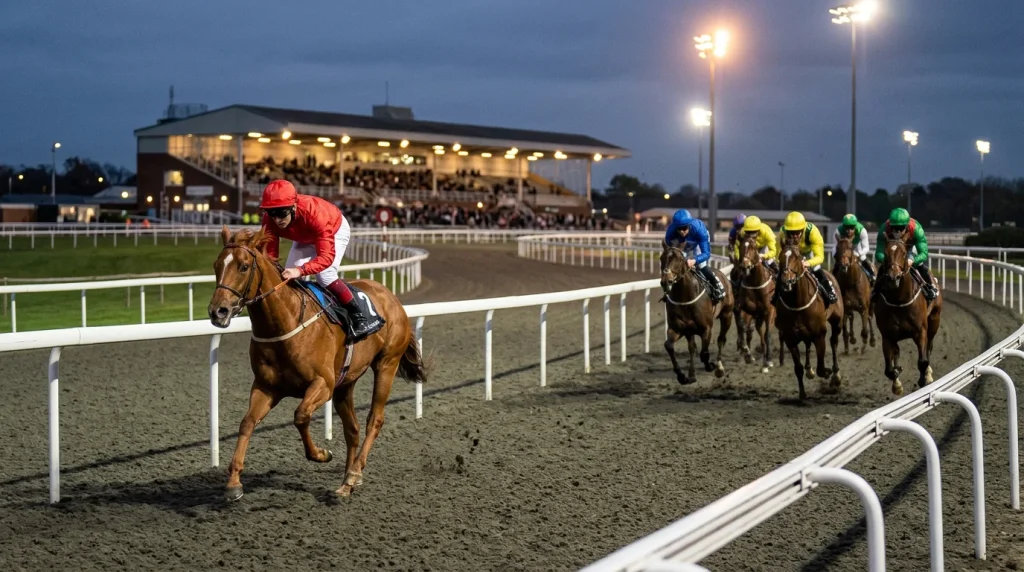
Speed Pays — But Not at Every Distance
Wolverhampton pace bias is one of the most exploitable patterns in British all-weather racing. At five furlongs, front-runners at Dunstall Park have delivered a profit of 70p in every pound staked over six seasons of handicap data — a return that would make any systematic bettor pay attention. The track’s tight left-handed bends, short straights, and Tapeta surface create conditions where going forward early is not merely a tactical option but a structural advantage, at least at the shorter distances.
This article breaks down pace bias distance by distance, using profit-and-loss data from Sandracer and running-style analysis from Geegeez. The patterns are not uniform. What works at five furlongs becomes less powerful at six, turns ambiguous at seven, and largely disappears at a mile and beyond. Understanding where the edge exists — and where it does not — is the difference between applying a profitable filter and misapplying a rule that costs money at the wrong distance.
The data also interacts with draw bias, covered in detail in the companion article on stall statistics. A front-runner drawn low at five furlongs is the highest-probability profile in the dataset. A hold-up horse drawn high at the same distance is the lowest. Between those extremes, every combination of pace style and stall position carries an implied expected value that the market does not fully price in. The numbers are here. The question is whether you use them.
What Pace Bias Means and How Wolverhampton Creates It
Pace bias exists when one running style — front-running, tracking the pace, or being held up for a late run — wins more often than the market expects across a statistically significant sample. Every track has some degree of pace bias, shaped by geometry, going, and field size. What separates Wolverhampton from most venues is the size and consistency of its bias at sprint distances.
The mechanics are geometrical. Wolverhampton’s oval is approximately one mile in circumference, which is tight by all-weather standards. The home straight is roughly two furlongs — short enough that a horse making ground from behind has limited room to close the gap. The bends are correspondingly sharp, and horses racing wide through them lose more ground than they would on a sweeping galloping track. A front-runner hugging the inside rail travels the shortest possible route. Every other horse in the field travels further. At sprint distances, where the winning margin is often a neck or a short head, that difference in ground covered translates directly into results.
The Tapeta surface adds a secondary effect. Tapeta absorbs slightly more energy per stride than Polytrack, which means sustained acceleration — the kind a hold-up horse needs to close from four or five lengths off the pace in the final furlong — burns more fuel. The front-runner, by contrast, travels at a steady tempo and does not need to accelerate sharply. The surface rewards efficiency over explosiveness, which biases the track toward horses that establish their position early and defend it.
The metrics used to measure pace bias are the same as those applied to draw data: win rate by running style, A/E, and level-stakes profit or loss. The running style classifications — front-runner, prominent, mid-division, held up — are assigned retrospectively based on where a horse was positioned in the early stages of the race. Front-runners are horses that led or disputed the lead in the first two furlongs. Held-up horses are those that raced in the rear half of the field. The classifications are imperfect — a horse can change style between runs — but across hundreds of races, the patterns they reveal are robust.
Five Furlongs — Where Front-Runners Rule
The five-furlong data at Wolverhampton is the headline act of pace bias analysis. According to Sandracer’s dataset, front-runners in five-furlong handicaps show a 35% win rate in recent seasons, against a long-term average of 20%. The A/E value is 1.48 — meaning these horses win nearly fifty per cent more often than the betting market predicts — and the cumulative profit stands at 70p in every pound staked over six seasons of data. For context, a 70p profit per pound is an implied edge that most professional bettors would consider exceptional for any single angle.
The win rate alone understates the consistency of the pattern. Front-runners at this distance do not just win more often — they win in a way that defeats the market’s attempts to price them correctly. The odds available on front-runners at five furlongs at Wolverhampton are routinely too generous, which implies that the betting public underweights the positional advantage these horses hold. The market treats front-running as one factor among many. The data says it is the factor at this trip.
The mirror image is equally instructive. Held-up favourites at five furlongs return a loss of 51p in every pound staked, according to running-style analysis from Geegeez. That is not a marginal loss — it is catastrophic. If the market sends off a held-up horse as favourite in a five-furlong sprint at Wolverhampton, it is overrating that horse by a margin that wipes out any edge the form might otherwise provide. The favourite is expected to come from behind and overhaul the leaders in a two-furlong straight on a tight-turning track. The data says that plan fails, repeatedly, at odds that do not compensate for the failure rate.
Why is the bias so extreme at five furlongs? Three factors converge. First, the start is on a chute that feeds almost directly into the home turn, which means the race is effectively decided by the time the field straightens up. A horse that leads into the turn has the rail, the shortest route, and daylight in front. A horse held up in mid-pack has to navigate traffic, find room, and accelerate on a surface that penalises sudden bursts of speed. Second, field sizes at five furlongs tend to be large — ten, eleven, twelve runners — which amplifies the traffic problem for closers. Third, the straight is too short. Two furlongs is not enough room for a horse making up three or four lengths against a leader that is already on the bit and racing efficiently on the inside rail.
The five-furlong pace bias at Wolverhampton is not a marginal statistical anomaly. It is a structural feature of the track, confirmed over thousands of races and multiple seasons, and it produces returns that are difficult to explain away as noise. Any approach to Wolverhampton sprint handicaps that does not begin with the question “who is going to lead?” is ignoring the most profitable piece of information on the racecard.
Six Furlongs — A Smaller Edge, Still Worth Taking
At six furlongs, the front-running advantage shrinks but does not disappear. Sandracer’s data records a 14% win rate for front-runners at this distance — less than half the five-furlong figure — but the cumulative profit remains positive: £117.80 to level £1 stakes since 2017. The lower win rate reflects the extra furlong of running, which gives the rest of the field more time to organise and more straight to close the gap. The still-positive profit line reflects the fact that the market has not fully adjusted to the front-running edge even at this distance.
The connection between pace and draw is tighter at six furlongs than at any other distance. The companion article on draw bias identifies stall five as the most profitable berth at this trip, with an LSP of +65.42 over five seasons. Stall five is not the inside rail, but it is close enough to secure a prominent position through the bend without being squeezed against it. A front-runner drawn in stall five at six furlongs has both the pace advantage and the positional advantage working in the same direction — a double filter that narrows the field significantly and raises the expected value of the selection.
Hold-up horses fare better at six furlongs than at five, but the improvement is relative rather than absolute. The losses for closers are smaller, the conversion rate is higher, and the market does a slightly better job of pricing them. The extra furlong gives held-up horses enough room to find daylight — sometimes — but the structural bias still favours prominently raced types. A hold-up favourite at six furlongs is a less disastrous proposition than a hold-up favourite at five, but it is still not a profitable one over the long term.
The practical difference between five and six furlongs at Wolverhampton comes down to confidence. At five furlongs, the front-running bias is strong enough to use as a primary filter — you can shortlist front-runners and effectively ignore hold-up horses without missing much value. At six furlongs, the bias is a secondary filter. It tilts the odds in one direction, but form, class, and the draw matter more than at the minimum trip. The front-runner drawn in stall five remains the ideal profile; the hold-up horse drawn wide remains the worst. But the distance between those two extremes is narrower, and mid-pack runners with tactical speed occupy a viable middle ground that barely exists at five furlongs.
One pattern specific to six furlongs deserves attention: the front-runner that leads at a moderate pace rather than blazing. At five furlongs, speed is everything — the race is over in under a minute, and the leader wins by holding tempo. At six furlongs, a leader who goes too fast can empty the tank before the straight and get caught. The most profitable front-runners at this distance are those with a record of controlling the pace rather than sprinting from the gate. Identifying them requires looking at sectional times where available, or at the pattern of their previous wins — did they make all comfortably, or did they cling on grimly? The former type is the one to back.
Seven Furlongs and Beyond — When Patience Stops Paying
At seven furlongs, the pace bias narrative shifts. Front-runners still hold a mild edge, but the dramatic profitability seen at sprint distances fades. The more interesting finding at this trip is on the opposite side of the equation: held-up favourites perform poorly enough to constitute a clear negative signal.
Geegeez’s running-style data shows that held-up favourites at seven furlongs at Wolverhampton win roughly one race in six and return a loss of 43p in the pound. The figure is less extreme than the 51p loss at five furlongs, but it is still a significant and sustained drain. The market sends these horses off at prices that imply they should win one in three or better. The track says otherwise. The seven-furlong start sits on the back of the oval, which means the field negotiates the far bend and the home turn before reaching the straight. A horse held up through both bends is racing wider, losing ground, and spending energy that cannot be recovered in a short finishing straight. The geometry punishes patience at this distance just as it does at shorter ones — less severely, but reliably.
The Lady Wulfruna Stakes, Wolverhampton’s sole Listed race, is run over seven furlongs and thirty-six yards. In this context, pace data carries a particular weight. The race attracts better-quality fields than a typical Wolverhampton handicap, but the track geometry is unchanged. Closers drawn wide face the same structural disadvantage in a Listed contest as they do in a Class 6 seller. The market often treats higher-class races as though the superior ability of the runners overrides track bias. At Wolverhampton, the bias is physical, not conditional — it does not care about official ratings.
At a mile and beyond, the pace bias data loses its directional clarity. Front-runners at a mile show win rates close to the long-term average, and their LSP fluctuates around break-even. The extra distance gives every horse in the field time to find position, and the field strings out enough to reduce the traffic problems that punish hold-up horses at shorter distances. At a mile and one furlong, and even more at a mile and four furlongs, running style is a marginal factor at best. The race is won on ability, fitness, and tactical execution rather than on where the horse was positioned leaving the stalls.
The practical rule is straightforward. If the race is seven furlongs or shorter, pace bias is a factor — front-runners gain, hold-up horses lose. If the race is a mile or longer, pace bias can be deprioritised in favour of form, class, and the trainer-jockey signals covered elsewhere. The transition is gradual, not binary, but the seven-furlong mark is where the data tips from meaningful to marginal.
Pace and Draw Combined — The Double Filter
Draw bias and pace bias at Wolverhampton are not independent variables. They interact, and the interaction amplifies both. A low-drawn front-runner at five furlongs benefits from the draw (shortest route to the rail) and the pace style (leading is structurally rewarded). Neither advantage alone is as powerful as both together. The cross-analysis — filtering for horses that satisfy both conditions simultaneously — produces the sharpest edges in the dataset.
At five furlongs, a front-runner drawn in stalls one to four is the highest-probability profile. The horse breaks from a position that allows it to reach the rail in one or two strides, dictates the pace from the front, travels the shortest route through the bend, and defends the lead into a straight that is too short for closers to overhaul. Every element of the track geometry, the surface, and the race dynamics works in this horse’s favour. Over the five-year sample, the LSP for this combined profile exceeds the LSP for either front-runners in general or low draws in general, because the two edges compound.
At six furlongs, the optimal profile shifts slightly. The ideal combination is a prominently raced horse — not necessarily an outright leader, but one that tracks the pace within two lengths — drawn in stalls two to six. Stall five, as noted in the draw analysis, is the standout berth, and a pace-prominent runner in stall five at six furlongs occupies the sweet spot of both datasets. The rider has room to breathe, a clean run through the bend, and a short enough straight to defend any advantage established in the first four furlongs.
At seven furlongs, the combined filter is less about finding winners and more about eliminating losers. A held-up horse drawn in stall nine — the worst single berth at this distance — faces a pace disadvantage (closers lose money at seven furlongs), a draw disadvantage (stall nine has the worst LSP), and a tactical disadvantage (the rider is likely to sit mid-pack, mid-track, and lose ground on both bends). Removing this profile from the shortlist does not guarantee that the remaining runners will include the winner, but it removes the selection that the data most strongly identifies as a losing bet.
The double filter works because the market prices draw and pace separately — when it prices them at all. Most bettors consider form and class first, and many do not consider draw or pace at all. Those who do tend to look at one or the other, not both. The punter who cross-references stall position with running style is working with information that the majority of the market ignores, which is exactly the condition under which long-term edges survive. The edge is not large enough to overcome a weak horse. It is large enough to tip a competitive handicap where three or four runners are closely matched on form.
Identifying Front-Runners Before the Off
The pace data is only useful if you can identify which horse is likely to lead before the race begins. Running-style classifications are retrospective — they describe what happened, not what will happen. Predicting pace requires a different kind of homework.
The most reliable indicator is positional history. If a horse has led or raced prominently in its last three runs, it is likely to do so again. Running style in flat racing is largely habitual: horses that are trained to jump and lead tend to repeat the pattern, and jockeys booked onto known front-runners are expected to employ the style. The form book, not the racecard, is where this information lives. Check the in-running comments for phrases like “led,” “made all,” “disputed lead,” or “prominent” — these signal a horse that races near the front by design rather than by accident.
Headgear changes offer a secondary clue. First-time blinkers or a visor are often applied to encourage a horse to race more keenly — that is, further forward in the field. A trainer fitting blinkers to a horse that has previously been held up may be signalling a change in tactical approach. If that horse is drawn low in a Wolverhampton sprint, the combination of headgear, draw, and the likely instruction to go forward makes it a pace-bias candidate even without a front-running history.
Trainer intent is harder to read but occasionally visible. Some trainers are known for front-running tactics at Wolverhampton — their horses lead regardless of the jockey booked. Others vary their approach. The trainer-jockey combination data from the companion article can help here: if a trainer’s winners at Wolverhampton have been disproportionately front-runners, and that trainer has a runner today, the likelihood of a positive pace style is elevated.
Walter Glynn of Raceform UK captured the broader advantage of synthetic surfaces for pace analysis when he noted that bettors initially had doubts about synthetic tracks but quickly recognised that these surfaces were more reliable and consistent than even the best turf. That consistency is what makes Wolverhampton’s pace bias exploitable. On turf, going changes race to race, which disrupts pace patterns. On Tapeta, the going is near-constant, which means the pace data holds its shape from one meeting to the next. A front-running edge measured over six seasons on a surface that barely changes is an edge you can trust — provided you do the work to identify which horse will be on the lead before the stalls open.
Wolverhampton Pace Bias — More on this topic at wolverhampton race results.
See also Wolverhampton vs UK All-Weather Tracks.
