
Wolverhampton vs UK All-Weather Tracks — AW Course Comparison
 Available in US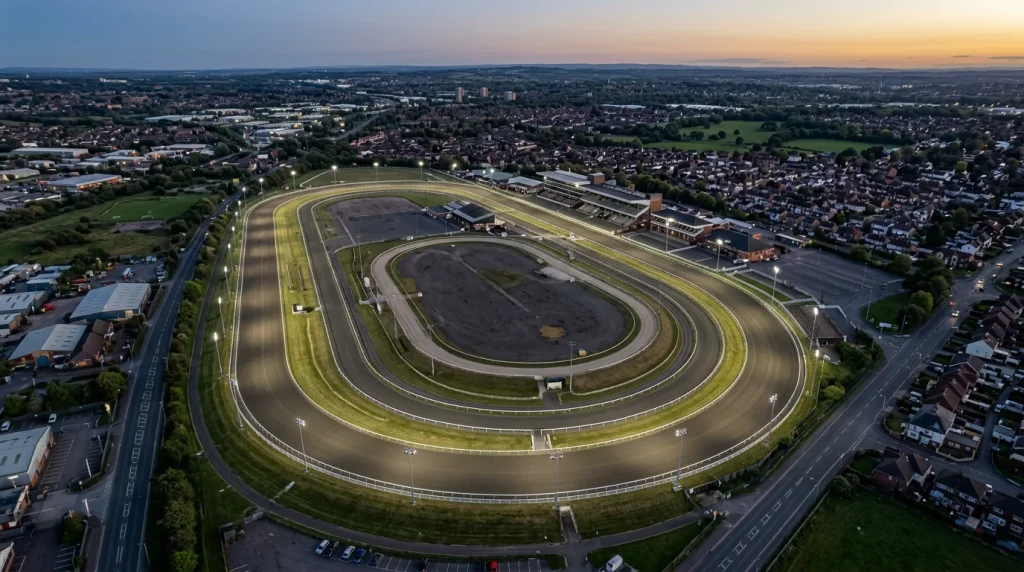
Six Tracks, Six Surfaces, Six Different Edges
Wolverhampton racecourse is one of six all-weather venues in Britain, and understanding it properly requires understanding the context it sits within. Each AW track has its own surface, its own geometry, its own biases, and its own place in the racing calendar. A horse that wins at Wolverhampton is not necessarily suited to Lingfield. A jockey who thrives at Newcastle may struggle at Southwell. The six venues share the label “all-weather” but differ in almost every particular that matters to form students and bettors.
This article compares Wolverhampton with Lingfield, Kempton, Newcastle, Chelmsford, and Southwell across the dimensions that shape race results: surface type, track direction and circumference, typical field sizes, fixture scheduling, and the draw and pace biases that each layout produces. The comparison is not intended to rank the tracks — each has its own appeal and its own niche — but to clarify what makes Wolverhampton distinct and to help anyone moving form between AW venues understand which transfers are reliable and which are not.
The differences are not trivial. The six tracks run on three different surface families. They range from sharp, tight ovals to long, galloping layouts. Some host racing predominantly in the evening under floodlights; others race during the day. The All-Weather Championships, a series of more than 200 qualifying fixtures across all six venues, culminates in a £1 million Finals Day — but the road to Finals Day passes through tracks that have almost nothing in common beyond the fact that they race on synthetic ground.
All-Weather Tracks at a Glance — The Comparison Table
Before drilling into the details, the essential specifications of each track side by side. These are the numbers that define how each venue rides, how the races unfold, and what types of horse tend to prosper.
Wolverhampton (Dunstall Park) — Surface: Tapeta. Direction: left-handed. Circumference: approximately 1 mile. Straight: ~2 furlongs. Floodlights: yes. Key distances: 5f, 6f, 7f 36y, 1m 1f 104y, 1m 4f 50y. Signature race: Lady Wulfruna Stakes (Listed, 7f 36y). The tightest oval of the six and the busiest AW fixture list in the country.
Lingfield Park — Surface: Polytrack. Direction: left-handed. Circumference: approximately 1 mile 2 furlongs. Straight: ~2.5 furlongs. Floodlights: no. Key distances: 5f, 6f, 7f, 1m 1y, 1m 2f. Signature race: Winter Derby (Group 3, 1m 2f — historically at Lingfield, temporarily at Southwell from 2026, returning to Lingfield in 2026). A slightly larger oval than Wolverhampton, with a longer home straight that gives hold-up horses a better chance. The track also hosts turf racing on its separate course.
Kempton Park — Surface: Polytrack. Direction: right-handed. Circumference: approximately 1 mile 3 furlongs. Straight: ~3 furlongs. Floodlights: yes. Key distances: 5f, 6f, 7f, 1m, 1m 3f. Signature race: September Stakes (Listed, 1m 3f). The only right-handed AW track in Britain. The longer straight and more gradual bends produce a flatter, more galloping contest than Wolverhampton’s tight turns.
Newcastle (Gosforth Park) — Surface: Tapeta. Direction: left-handed. Circumference: approximately 1 mile 2 furlongs. Straight: ~4 furlongs. Floodlights: yes. Key distances: 5f, 6f, 7f, 1m, 1m 2f 42y, 2m 56y. Signature race: Northumberland Plate (Heritage Handicap, 2m 56y — turf), plus Eider Chase (NH). Newcastle shares Wolverhampton’s Tapeta surface but in a completely different layout. The four-furlong home straight is the longest of any AW track in Britain, which significantly reduces front-running bias and favours closers more than any other venue in the comparison.
Chelmsford City — Surface: Polytrack. Direction: left-handed. Circumference: approximately 1 mile 1 furlong. Straight: ~2.5 furlongs. Floodlights: yes. Key distances: 5f, 6f, 7f, 1m, 1m 2f. Signature race: Chelmsford City Cup (Heritage Handicap, 1m 2f). A modern venue opened in 2015 (as the replacement for Great Leighs). The Polytrack here tends to ride fast in dry conditions, and the track has built a reputation for producing quick times.
Southwell — Surface: Tapeta (switched from Fibresand in 2021). Direction: left-handed. Circumference: approximately 1 mile. Straight: ~3 furlongs. Floodlights: yes. Key distances: 5f, 6f, 7f, 1m, 1m 3f, 2m. Signature race: none at Pattern level. Southwell was the last British AW venue to race on Fibresand until it adopted Tapeta in December 2021. Historical Fibresand form at the track transfers poorly to the current surface, and the venue is still building its Tapeta dataset.
The specifications alone tell a story. Wolverhampton, Newcastle, and Southwell all race on Tapeta but differ in circumference and straight length. Wolverhampton and Newcastle share a surface but differ in straight length by a factor of two — a difference that flips the pace bias from front-runner-friendly to closer-friendly. Lingfield, Kempton, and Chelmsford provide the Polytrack contingent. The comparison is never as simple as “all-weather is all-weather.” Each track is its own puzzle.
Surface Differences — Tapeta, Polytrack and Fibresand
The three surface families in use across British AW racing are Tapeta and Polytrack — Fibresand was retired when Southwell switched to Tapeta in 2021. They share the goal of providing a safe, consistent racing surface that can withstand year-round use, but their compositions differ enough to produce measurably different race dynamics.
Tapeta, installed at Wolverhampton in 2014 — the first UK venue to adopt it — and subsequently at Newcastle (2016) and Southwell (2021), is a blend of wax-coated sand, synthetic fibres, and recycled rubber. The wax coating drives water through the profile rather than letting it pool on top, which produces the most consistent going of any surface type. Wolverhampton’s official going is almost always “standard” or “standard to slow,” regardless of weather. The surface absorbs slightly more energy per stride than Polytrack, favouring horses with an efficient, rhythmic action over those who rely on explosive acceleration.
Polytrack, used at Lingfield, Kempton, and Chelmsford, is the most common AW surface in Britain. It is also a sand-and-fibre blend with a wax binder, but the engineering of the wax layer differs from Tapeta, and the riding characteristics differ accordingly. Polytrack tends to ride firmer and faster, particularly at Chelmsford, where dry conditions produce some of the quickest all-weather times in the country. The surface rewards speed and a sharp turn of foot, and the going can vary more between meetings than on Tapeta. Horses that produce their best performances on quick Polytrack may find Tapeta slightly too deep, and vice versa.
Fibresand, formerly used on the flat course at Southwell until it was replaced by Tapeta in December 2021, was the oldest AW surface in Britain and the most distinct. It was abrasive, deep, and energy-sapping. Times at Southwell were slower than at any other AW venue, and the surface demanded stamina even at sprint distances. Kickback was heavy, which affected hold-up horses more than at other tracks. Historical Fibresand form from Southwell transferred poorly to other AW venues. With Southwell now on Tapeta, no British track races on Fibresand.
For bettors moving form between tracks, the surface hierarchy of transferability runs roughly as follows. Tapeta to Tapeta (between Wolverhampton, Newcastle, and Southwell) is the most reliable cross-surface move, though Southwell’s Tapeta dataset is still building since its 2021 switch. Polytrack to Polytrack (between Lingfield, Kempton, and Chelmsford) is similarly dependable. Tapeta to Polytrack — or Polytrack to Tapeta — works more often than not, but with enough exceptions to warrant caution. Historical Fibresand form from Southwell before the 2021 switch should be treated with scepticism.
Field Sizes and Race Quality Across AW Venues
Field size is one of the most underrated variables in race analysis. Larger fields produce more competitive races, more unpredictable results, and — for bettors — more opportunities to find value at prices that reflect genuine uncertainty. Smaller fields concentrate the market’s attention on fewer runners, which tends to produce more accurate odds and less room for an edge.
All-weather racing in Britain has seen a notable improvement in field sizes in recent years. According to the BHA’s February 2026 Racing Report, 73% of all-weather flat races in January and February 2026 attracted fields of eight or more runners — the best proportion since 2007. The improvement was spread across venues but was particularly marked at Wolverhampton and Chelmsford, where evening fixtures and competitive handicap programmes drew consistent entry levels.
Wolverhampton’s field sizes benefit from two factors. First, the sheer volume of fixtures — the heaviest schedule of any AW venue — means there are always races available for trainers looking for an entry, which distributes the horse population across a deep calendar rather than concentrating it into a few high-profile meetings. Second, the Tapeta surface suits a wide range of horse types, which encourages entries from yards that might bypass a venue with a more specialist surface. The result is that Wolverhampton handicaps regularly attract ten to twelve runners at sprint distances, which is where the draw and pace biases documented in the companion articles are at their strongest.
Chelmsford produces similarly healthy field sizes, aided by floodlights and a location within commuting distance of Newmarket. Kempton’s fields are typically competitive at shorter distances but can thin out at a mile and beyond. Newcastle draws good fields for its feature meetings but can struggle on lower-profile midweek cards, particularly in summer when the turf programme competes for entries. Lingfield, which races both on its AW track and its turf course, occasionally splits its horse population across codes, which can depress AW field sizes on dual-surface days. Southwell’s field sizes, historically suppressed by the demanding Fibresand surface, are still rebuilding since the switch to Tapeta in 2021, and average fields here remain the smallest of the six.
Fixtures and Scheduling — Who Races When
The All-Weather Championships, a season-long series administered by Arena Racing Company, ties the six AW venues together into a competitive framework. The series encompasses more than 200 qualifying fixtures across the season, with championship points awarded for performances in designated races. The culmination is Finals Day, held on Good Friday, with a prize pool of £1 million — the richest single day in all-weather racing anywhere in the world. Wolverhampton, Chelmsford, Kempton, Lingfield, Newcastle, and Southwell all contribute qualifying races, but the distribution is not even.
Wolverhampton leads the pack in volume. The track hosts more than eighty fixtures per year, the majority of them evening meetings under floodlights. This makes Dunstall Park the backbone of the AW schedule — there are weeks during the winter when Wolverhampton races two or three times, providing content for betting shops, broadcasters, and online platforms when the turf card is bare. The evening scheduling is deliberate: it avoids clashing with the daytime turf programme in summer and fills the gap left by the absence of evening turf meetings in winter.
Chelmsford runs a similarly intensive schedule, with a mix of afternoon and evening fixtures. Kempton contributes substantially, particularly during the winter jumps season when its AW meetings complement the high-profile National Hunt cards at the same venue. Newcastle’s AW programme sits alongside a turf fixture list, and the track’s location in the north-east of England means it serves a different geographical catchment from the southern-based venues. Lingfield’s AW schedule is lighter, partly because the track shares its calendar with turf fixtures on its separate course. Southwell’s programme draws the smallest share of the AW schedule.
For bettors, the scheduling has practical implications. Evening meetings at Wolverhampton and Chelmsford tend to attract different market conditions from afternoon meetings at Kempton or Lingfield. Liquidity in the betting exchanges is thinner in the evening, which means prices can be more volatile and overreactions more common. Trainers who target evening meetings specifically — running horses under floodlights at Wolverhampton as a deliberate campaign strategy — can exploit the thinner market, and the data shows that certain yards perform disproportionately well at evening fixtures compared to their overall strike rates.
Draw Bias and Pace Bias Across the Six Tracks
Draw bias and pace bias are not unique to Wolverhampton, but the shape and strength of these biases differ markedly across the six AW venues. Understanding those differences is essential for anyone who bets across tracks rather than specialising at one venue.
Wolverhampton’s draw bias is the most pronounced at sprint distances, driven by the tight turns and short straight documented in the companion article. Low draws dominate at five and six furlongs. Front-runners profit at every sprint distance. The biases are structural — a product of the track’s geometry — and persistent across seasons.
Newcastle, despite sharing Tapeta with Wolverhampton, produces a very different bias profile. The four-furlong home straight — twice the length of Wolverhampton’s — gives hold-up horses far more room to close. Front-running bias at Newcastle is much weaker, and at middle distances the track actively favours closers. The draw matters less at Newcastle because the straight is long enough for wide-drawn horses to recover. If Wolverhampton is the front-runner’s track, Newcastle is the patient rider’s track.
Kempton, the only right-handed AW venue, has its own draw quirks. High draws tend to be favoured at sprint distances — the mirror image of Wolverhampton’s low-draw advantage — because the right-handed turns give the outer stalls the inside position. The three-furlong straight is long enough to reduce pace bias compared to Wolverhampton but short enough that front-runners still hold a mild edge at five furlongs. At a mile and beyond, Kempton rides relatively fairly with minimal draw or pace distortion.
Lingfield’s left-handed oval is slightly larger than Wolverhampton’s, with a longer straight that softens the draw bias at sprint distances. Low draws are favoured but the edge is smaller than at Dunstall Park. The pace profile is relatively neutral — front-runners and hold-up horses perform close to market expectation across most distances. Chelmsford, also left-handed, produces moderate draw biases at sprints and relatively even pace data. The track is wide enough to give jockeys options, which reduces the cost of a bad draw.
Southwell’s switch from Fibresand to Tapeta in 2021 changed the track’s character significantly. Under Fibresand, the surface was deep and energy-sapping, meaning front-runners who went hard early could tire dramatically in the final furlong. On Tapeta, the pace and draw bias patterns are still stabilising, but early data suggests the track now rides more similarly to Wolverhampton and Newcastle than it did in its Fibresand era. Bettors should treat pre-2022 Southwell form with caution, as the surface shift effectively reset the form book.
The overarching lesson is that “all-weather” is not a single category. Each track produces its own biases, its own form patterns, and its own betting angles. Moving form between venues without adjusting for these differences is a common and costly error — a horse that made all at Wolverhampton and won by three lengths may have done so because the track rewarded front-running, not because the horse is three lengths better than the rest of the field. At Newcastle, with twice the straight and a different pace profile, the same horse might be caught in the final furlong. Conversely, a closer that never fires at Wolverhampton might come alive at Newcastle where the straight gives them room to finish. The six-track comparison is a starting point, not a conclusion — the details within each venue are where the real edges live, and the punter who adjusts for track-specific bias will outperform the one who lumps all synthetic form together.
Horses in Training and the Role of All-Weather Racing
The all-weather programme does not exist in a vacuum. It operates within a British racing industry that is navigating structural pressures, and understanding those pressures explains why the AW circuit — and Wolverhampton in particular — has grown in significance over the past decade.
The BHA’s 2026 Racing Report records 21,728 horses in training across Britain, a decline of 2.3% compared to 2026 and the continuation of a downward trend that has run since 2022. Fewer horses in training means fewer available runners per fixture, which puts pressure on field sizes and raises questions about the sustainability of the fixture list at its current volume. The all-weather programme is both a victim and a beneficiary of this trend. On the one hand, fewer horses make it harder to fill cards. On the other, the AW venues’ year-round scheduling and consistent surfaces make them attractive to trainers looking to maximise runs from a smaller string — a horse that cannot run on soft ground in November can run on Tapeta at Wolverhampton instead.
The macro context extends beyond the horse population. Betting turnover on British racing fell 6.8% in 2026, and the broader industry relies on a complex ecosystem of levy income, media rights, and prize money to fund the racing calendar. All-weather tracks, which race year-round and generate consistent broadcast content, contribute disproportionately to the media-rights revenue that underpins the sport’s finances. Wolverhampton’s dense evening programme provides a steady stream of product for betting platforms, particularly during the winter months when the turf programme is reduced.
Globally, the momentum behind all-weather and synthetic racing is building. Dave O’Rourke, President and CEO of the New York Racing Association, stated that the relevant data unequivocally supported a shift to all-weather surfaces for winter racing — a position that led NYRA to commit to a full Tapeta programme at Belmont Park from 2026. The American adoption of Tapeta, driven by safety data and welfare concerns, validates the direction that Wolverhampton and Newcastle have been travelling for years. If the global trend continues, the distinction between “all-weather” and “mainstream” racing may erode further, and Britain’s AW venues will look less like a niche circuit and more like the core of a twelve-month sport.
For now, the six tracks serve complementary purposes. Wolverhampton provides volume and consistency. Newcastle adds Tapeta breadth and a contrasting layout. Southwell, now also on Tapeta, is rebuilding its identity after the 2021 surface switch. Kempton, Lingfield, and Chelmsford supply the Polytrack backbone. Together, they ensure that British flat racing never stops — and that the form student, the bettor, and the trainer always have somewhere to run.
Wolverhampton vs UK All-Weather Tracks — More on this topic at wolverhampton race results.
See also Wolverhampton Results Today.
