
Wolverhampton Odds Today — SP Comparison and Market Movers
 Available in US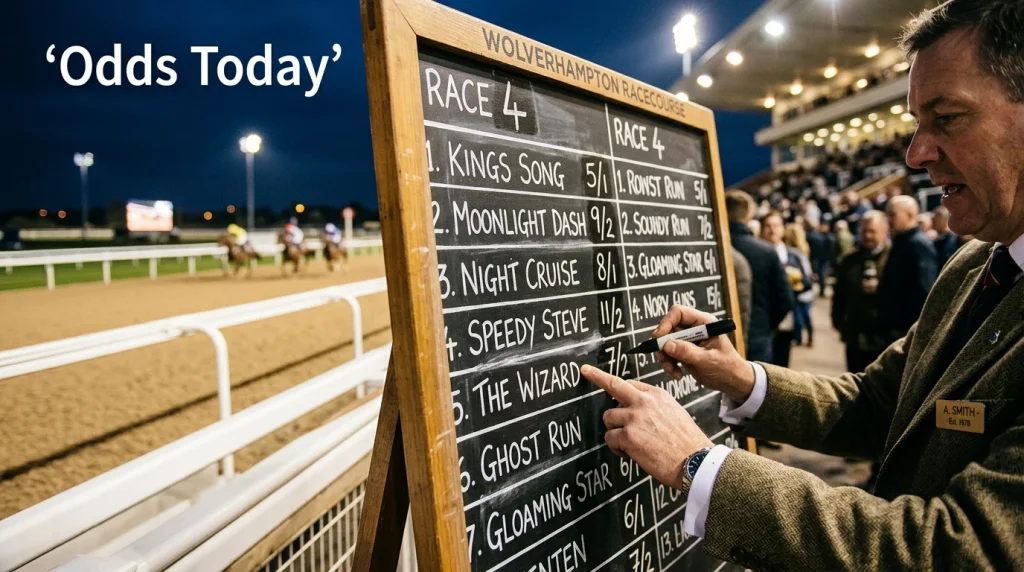
Wolverhampton odds today reflect the market’s collective assessment of every runner on this evening’s — or this afternoon’s — card at Dunstall Park. Understanding how those odds are formed, when they move, and what the movements mean is as important as studying the form itself. A horse can be the best thing on the racecard and still be a poor bet if the price is too short. Equally, a runner whose odds drift without explanation may be offering value the market has overlooked.
This page breaks down the mechanics behind Wolverhampton’s betting market: how odds are set, what distinguishes a steamer from a drifter, and how to decide whether to take an early price or wait for the starting price. If you bet on racing at Dunstall Park with any regularity, the difference between a good price and a bad one will show up in your profit-and-loss more clearly than almost any other factor.
Odds are updated throughout the day as the market develops, from the overnight tissue prices through the morning shows to the final on-course SP. What you see here is a guide to reading that process, not a snapshot of a single moment.
How Wolverhampton Odds Are Formed
The odds you see for any Wolverhampton race are the product of several overlapping mechanisms, and none of them is a pure expression of a horse’s true chance. The starting price (SP) is the on-course price returned by the official SP reporters at the moment the stalls open. It is compiled from the prices offered by on-course bookmakers in the betting ring — the physical market that still exists at every British racecourse, even if it represents a shrinking fraction of total betting volume.
Before the SP is struck, there is a sequence. The overnight tissue is a bookmaker’s opening estimate of likely prices, published the evening before. The morning shows — typically from 09:00 or 10:00 — are the first tradeable odds offered by fixed-odds bookmakers online. These early prices can differ substantially from the eventual SP, particularly at Wolverhampton evening meetings, where the on-course ring is smaller and less liquid than at major Saturday turf fixtures.
The overround is the bookmaker’s margin built into the total book. If you convert every horse’s odds into implied probabilities and sum them, the total will exceed 100%. The amount by which it exceeds 100% is the overround — the bookmaker’s theoretical edge. At Wolverhampton, where fields typically range from eight to twelve runners, the overround on a standard evening handicap might sit between 115% and 125%. Larger fields push it higher; smaller fields compress it. Exchange markets on Betfair operate without a built-in overround, which is one reason exchange odds are often more generous than fixed-odds prices, though you pay commission on winnings instead.
British racing’s total betting turnover fell by 6.8% in 2026, according to the BHA’s full-year racing report. That decline was driven partly by regulatory affordability checks, which cap how much certain customers can stake. Richard Wayman, the BHA’s Chief Operations Officer, has noted that the preference for high-profile fixtures is linked to the impact of affordability checks, with fewer larger-staking customers remaining in the market. The effect on liquidity is real: fewer big-staking punters means the market is thinner, price moves can be more volatile, and the gap between early morning odds and the SP can widen — especially at midweek all-weather meetings like Wolverhampton’s, which sit outside the premier-fixture bracket where the remaining big-staking activity is concentrated.
Market Movers — Reading the Signals
A market mover is a horse whose price shortens significantly between the opening show and the off. In common parlance, a horse that shortens is a “steamer” and one that lengthens is a “drifter.” Both carry information, though the quality of that information varies.
A steamer at Wolverhampton might shorten from 8/1 in the morning to 4/1 at the off. That move could signal several things: stable confidence, a strong piece of work reported by trackwork watchers, a tipster recommendation that drives public money, or simply a well-known yard booking a leading jockey at the last minute. Not all steamers win — the strike rate of heavily backed horses is better than average but far from certain — but the move itself tells you that money is talking.
Drifters are trickier. A horse that opens at 5/2 and drifts to 7/2 may have attracted negative whispers, or it may simply be drifting because the money is going elsewhere in the race. At Wolverhampton evening meetings, where overall betting volumes are lower than at big Saturday fixtures, a single large bet on one runner can push every other price outward without any negative information on the drifters. Context matters. A drift in a twelve-runner handicap at 18:30 on a Tuesday is less meaningful than the same drift in the Lady Wulfruna Stakes.
The most reliable market moves are sustained ones — a price that shortens gradually across the afternoon, from multiple bookmakers, without a single triggering event. That pattern suggests a consensus forming across independent sources of information, which is a stronger signal than a sudden lurch caused by one big bet hitting the exchange. Watch for horses that shorten on the fixed-odds boards and simultaneously tighten on Betfair: when both markets agree, the information behind the move is usually genuine.
SP Versus Early Prices — When to Take the Odds
The question of whether to take an early price or wait for the SP depends on what you think the market is going to do — and on whether you trust your own analysis more than you trust the crowd’s.
Early prices, typically available from the morning shows, tend to be wider than the eventual SP for horses that the market will back. If you have identified a selection that you believe will shorten — because the draw is favourable, the trainer has a strong Wolverhampton record, the jockey booking is significant — then taking the morning price locks in value that may not be there by the afternoon. The risk is that the horse drifts instead, and you have taken a shorter price than you needed to. But if your selection process is sound, the occasions when you capture value early should outnumber the occasions when you get it wrong.
Waiting for the SP makes sense in different circumstances. If you are unsure about a horse’s chance and want to see how the market develops, SP betting removes the need to commit early. It also avoids the scenario where you back a horse at 3/1 in the morning and it opens on-course at 5/1, leaving you with a demonstrably worse price. For casual bets or uncertain selections, SP is the path of least regret.
There is an intermediate option: the Betfair starting price (BSP), which is calculated from exchange liquidity at the moment the race begins. BSP typically returns a higher price than the on-course SP for lower-profile meetings like Wolverhampton midweek cards, because the exchange overround is lower. For punters comfortable with exchange betting, BSP offers a structural edge over traditional SP in many Dunstall Park races.
One small but telling number puts the financial ecosystem of a Wolverhampton race in perspective: the riding fee for a flat jockey in Britain is £162.79 per ride. A jockey riding six races on an evening card earns under a thousand pounds before expenses. The economics are tight at every level of this sport, and the punter who pays attention to price — not just to which horse might win, but at what odds — is operating with the same discipline the professionals need to survive.
Wolverhampton Odds Today — More on this topic at wolverhampton race results.
See also Wolverhampton Race Replays.
