
Wolverhampton Fixtures 2026 — Full Racing Calendar
 Available in US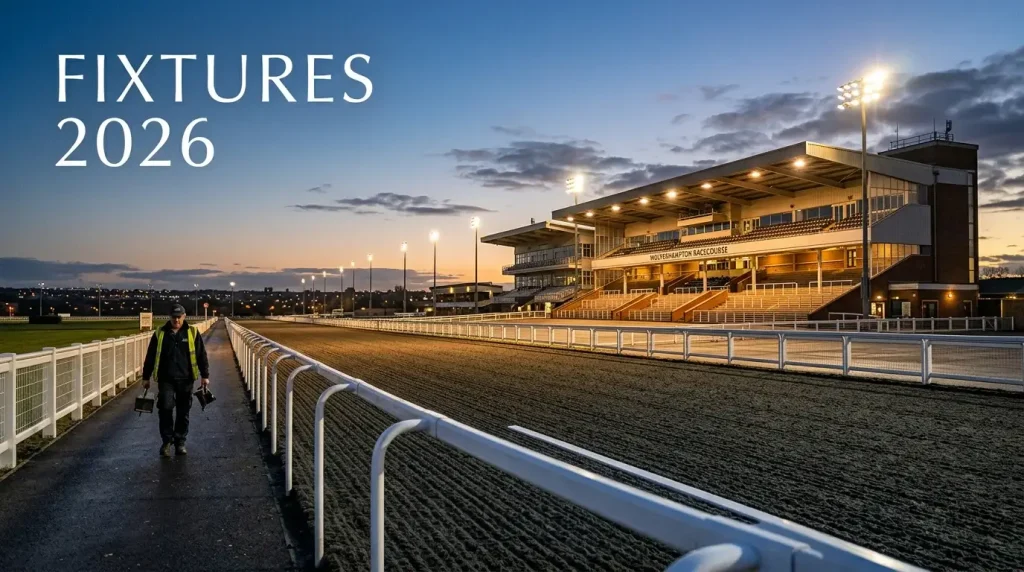
Wolverhampton fixtures 2026 cover more than 80 scheduled meetings at Dunstall Park, making it the busiest all-weather racecourse in Britain for yet another year. The calendar runs from January through December without a meaningful break — evening cards dominate the winter months, afternoon and twilight slots fill the summer schedule, and the overall rhythm barely pauses from one month to the next.
For punters, the fixture density is an asset. It means Wolverhampton form is always fresh, repeat runners are common, and the data that drives draw-bias and pace-bias analysis is constantly being refreshed. For racegoers, it means there is almost always a meeting to attend within the next few days. The 2026 season also brings new dimensions to the Dunstall Park experience, including the possibility of further dual horse-and-greyhound fixtures following the success of the inaugural event in March. Below is the full 2026 calendar, broken down by month, with the key dates and feature meetings highlighted.
Month-by-Month Fixture Breakdown
The Wolverhampton Racecourse fixture list for 2026 distributes meetings across the year with a clear seasonal pattern. The heaviest concentration falls in the winter months — November through February — when turf racing contracts and the all-weather tracks absorb the demand. The lightest months are typically June and July, when the flat turf season is at its peak and fixtures are shared across a wider pool of courses.
January and February are the backbone of the all-weather calendar. Wolverhampton typically stages eight to ten meetings per month in this window, with most running as evening cards under floodlights. These are the fixtures that produce the largest, most competitive fields — during January and February 2026, 73% of all-weather flat races in Britain attracted fields of eight or more runners, the best figure since 2007. For bettors who rely on draw-bias data, big fields are where the edge is sharpest.
March brings the Lady Wulfruna Stakes, the track’s flagship Listed race. The 2026 renewal marks the 25th running of the race, with a prize fund of £60,000, and it typically draws the highest-quality field of any Wolverhampton fixture outside the All-Weather Championships. March also marks the closing stretch of the AWC qualifying season, which means several meetings in the month carry extra significance for horses chasing championship points.
April begins with the All-Weather Championships Finals Day, held on Good Friday at Newcastle Racecourse — which, like Wolverhampton, races on Tapeta. While Finals Day itself takes place at Newcastle, the qualifying races run throughout the season at all six AW tracks — and Wolverhampton, as the busiest host, contributes more qualifying fixtures than any other course. April also sees the start of the turf flat season, which means Wolverhampton’s fixture count drops slightly as the BHA rebalances the schedule.
May through August is the quieter window. Wolverhampton still stages four to six meetings per month — far from dormant — but the mix shifts toward afternoon fixtures and lower-class cards. These summer meetings can actually be useful for punters: smaller fields and less media attention sometimes produce less efficient markets, where value can hide in plain sight.
September through December brings the return to full throttle. The turf season winds down, the jumps season begins, and the AW tracks pick up the slack. Wolverhampton’s evening cards resume their dominant position on the schedule, and field sizes start climbing again as trainers redirect horses from rain-affected turf to the consistent Tapeta surface. By November, the fixture list is back at peak density, and the cycle begins again.
Feature Meetings and Key Dates
Not all Wolverhampton fixtures are created equal. A handful of meetings each year carry extra weight — higher prize money, better-quality fields, or a significance that extends beyond the standard midweek card.
The Lady Wulfruna Stakes in March is the obvious headline act. As Wolverhampton’s only Listed race, it attracts runners from top yards who might not otherwise target an evening all-weather meeting. The 7f 36y distance is unique to this fixture and produces a specific draw-and-pace dynamic that does not apply to standard 7f races. The 25th running in 2026 will likely draw additional media and public attention, which typically translates into deeper betting markets and tighter overrounds.
All-Weather Championships qualifying races run throughout the season but cluster in the winter months. These races are flagged in the programme and carry championship points that determine which horses qualify for Finals Day. A horse that needs points late in the season may be targeted specifically at a Wolverhampton qualifier, which can produce unusually strong efforts from runners whose connections have a specific objective beyond the day’s prize money.
The dual fixture concept, launched on 7 March 2026 when Wolverhampton hosted the first combined horse racing and greyhound racing card in British sporting history, is another date to watch. That inaugural event produced a 43% increase in footfall compared with the equivalent date the previous year. If the format is repeated — and the early success strongly suggests it will be — dual-fixture dates become landmark meetings on the calendar, drawing a broader audience and a different atmosphere from a standard evening card.
Themed racedays — Ladies’ Day evenings, charity nights, seasonal events — appear periodically throughout the year. They do not change the racing itself, but they do affect the on-course crowd, the atmosphere and occasionally the betting ring dynamics. A busier ring can mean a more accurate SP; a quieter one can mean wider discrepancies between fixed-odds prices and the returned starting price.
Planning Your Visit to Dunstall Park
If you are attending rather than just betting remotely, a few practical details make the trip smoother. Wolverhampton evening meetings typically have a first race around 16:30 or 17:00, with the last race by 20:30. Gates open roughly an hour before the first, which gives time to study the card, check the going and find a spot before the action starts.
Advance booking is not always necessary for standard midweek meetings, but feature fixtures and themed racedays can sell out in the popular enclosures. Check the racecourse website for ticket availability before travelling. Dress codes are relaxed by racing standards — smart casual is the norm for most enclosures, and there is no requirement for morning dress or suits outside specific hospitality areas.
The racecourse is accessible by car via the A449, with 1,500 free parking spaces on site. Wolverhampton railway station is the nearest mainline stop, roughly two miles from the course, and taxis are readily available from the station rank. For evening meetings, the return journey by train is straightforward if the last race finishes before 20:30, though it is worth checking the train timetable for the specific night — services on some routes thin out after 21:00.
On course, the facilities reflect the £10 million investment programme completed by Arena Racing Company. The venue caters to racegoers, conferencing and events, and the standard of the bars, restaurants and viewing areas is noticeably higher than at many comparable all-weather tracks. The Dunstall Park Greyhound Stadium, which opened in September 2026 inside the horse racing circuit, adds another option for visitors on dual-fixture dates — you can watch both codes of racing from the same venue without moving between enclosures. Whether you are there for the racing, the atmosphere or both, Dunstall Park in 2026 is a different proposition from the Wolverhampton of a decade ago.
Wolverhampton Fixtures 2026 — More on this topic at wolverhampton race results.
See also Wolverhampton Going Report.
