
Wolverhampton Best Stall Positions — Where Draws Matter Most
 Available in US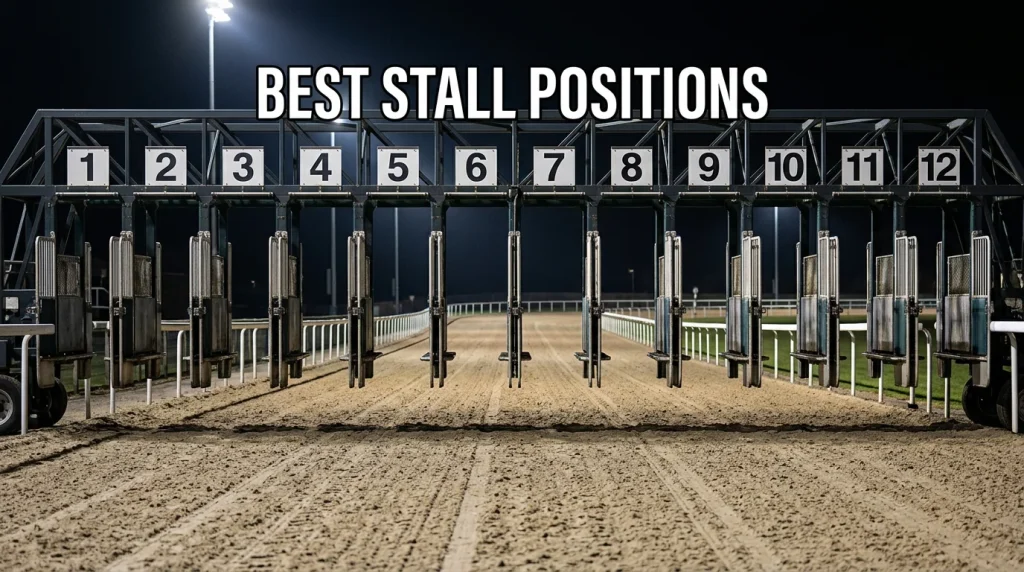
The Wolverhampton best stall position varies by distance, and at certain trips the difference between the most profitable stall and the most ruinous one is measured not in marginal percentages but in hundreds of points of level-stakes profit or loss. This page is the quick-reference version — a summary table of where to look and where to avoid, broken down by distance, built from five seasons of handicap data.
This is not the full draw-bias analysis. The detailed breakdowns, with complete stall-by-stall tables, win percentages and A/E ratios for every distance, are covered in the dedicated draw-bias pages. What this page gives you is the compressed output: best stalls, worst stalls, LSP range, and the critical field-size threshold below which the data loses its edge. If you want a quick answer before tonight’s card, start here. If you want the methodology, go deeper.
Best and Worst Stalls by Distance
The data below is drawn from OLBG’s Wolverhampton stall statistics, covering five seasons of handicap results from 2021 to 2026. All figures are level-stakes profit (LSP) to a £1 stake.
At five furlongs, the best stalls are consistently at the low end — stalls one through four. The tight left-handed bend that follows the starting chute compresses the field and gives inside-drawn horses a rail advantage that translates directly into positional priority through the first two furlongs. Outside draws — stalls ten and above in bigger fields — face a measurable disadvantage. The spread between the best and worst stall LSP at 5f is among the widest at any distance on any all-weather track in Britain.
At six furlongs, stall 5 has returned a level-stakes profit of +65.42 points over the five-year sample — the single most profitable stall-distance combination at Wolverhampton. The field enters the first bend from a slightly different angle than at 5f, which shifts the optimal position from the extreme inside to the low-middle range. Stalls one and two remain positive, but stall five hits the sweet spot between rail proximity and racing room. High draws at 6f are consistently negative, though the losses are less extreme than at 5f because the extra furlong gives wider-drawn horses fractionally more time to find a position before the bend.
At seven furlongs, the picture inverts at the high end. Stall 9 at 7f has produced a level-stakes loss of −287.42 points — the worst stall-distance combination on the course by a considerable margin. The mid-to-low stalls remain favourable, but the spread narrows compared with the sprints. The Lady Wulfruna distance of 7f 36y modifies the effect slightly due to its extended start position, but the underlying geometry — tight bends, short straight — still penalises wide draws in fields of ten or more.
At one mile and beyond, the draw bias fades toward irrelevance. Horses start on the round section of the oval, the first bend arrives when the field is still bunched, and the tactical shape of the race is determined by pace and ability rather than stall position. If you are betting on a 1m or 1m4f race at Wolverhampton, the draw is not the factor to prioritise — connections, form and pace scenario carry more weight at these trips.
At one mile one furlong and one mile four furlongs, the data shows no statistically significant stall bias in either direction. The samples are smaller than at sprint distances, which introduces more noise, but even adjusting for sample size the effect is negligible. The same applies at 1m6f, where too few races have been staged to draw reliable conclusions about any individual stall.
The Field-Size Threshold
The stall data above is built on averages that include a range of field sizes. But draw bias at Wolverhampton is not constant — it scales with the number of runners. The more horses in the race, the tighter the squeeze into the first bend, and the greater the advantage for those drawn closest to the rail. In smaller fields, there is more room on the track, the bend is less congested, and the penalty for being drawn wide shrinks accordingly.
The practical threshold is roughly eight runners. In fields of ten or more, the draw data holds strongly and should be treated as a primary filter in your analysis. In fields of eight or nine, the bias is present but less decisive — other factors may override it. In fields of six or fewer, the draw is close to neutral and should not be the basis for a betting decision on its own.
Non-runners can shift a race across this threshold between the time declarations close and the time the stalls open. A twelve-runner race that loses three withdrawals overnight becomes a nine-runner race, and the stall-five advantage that looked compelling at final declaration stage may have softened by the time you place your bet. Always check the final field size before applying the draw data — the numbers are built on averages, but you are betting on a specific race with a specific number of runners.
Field-size data works in both directions. During the winter months, Wolverhampton handicaps regularly attract fields of twelve to fourteen runners, particularly at 5f and 6f where the draw edge is sharpest. These are the races where the stall data is most powerful and most actionable. Conversely, summer afternoon cards and higher-class conditions races tend to draw smaller fields, reducing the draw effect and making other analytical angles relatively more important.
Applying Stall Data to the Racecard
The workflow is simple. Open the racecard. Check the distance. Look up the best and worst stalls for that distance in the table above. Check the field size — if it is ten or more, the data applies strongly; if it is below eight, treat it with caution. Then cross-reference with the pace data: at 5f and 6f, front-runners in handicaps have produced a 35% recent win rate with an A/E of 1.48, and the combination of low draw plus front-running style is the most profitable angle on the course.
A horse drawn in stall two at 5f with a confirmed front-running style and a trainer who targets Wolverhampton is ticking three boxes simultaneously — draw, pace and connections. A horse drawn in stall twelve at the same distance with a hold-up profile and a trainer with no Wolverhampton record is ticking none. The gap between those two profiles is not subtle. It is the difference between a data-backed selection and a hope-based punt.
The stall table is a filter, not a guarantee. Horses drawn in the worst stalls can still win if they are significantly better than their rivals. Horses drawn in the best stalls can still lose if the pace collapses, the horse dwells at the start, or the jockey misjudges the first bend. But over a series of bets — over fifty, over a hundred — the stall data tilts the balance measurably in your favour. That tilt is what separates systematic betting from guesswork.
One final reminder: stall data is a living dataset, not a historical monument. Each new meeting at Wolverhampton adds to the sample, and while the broad patterns have held firm across five seasons, the specific LSP figures for individual stalls will shift incrementally as new results come in. Use the data as a strong prior, not as a fixed law. If you track the numbers yourself across a full season, you will see how stable the trends are — and that stability is the strongest argument for making the stall table a permanent part of your Wolverhampton racecard analysis.
Wolverhampton Best Stall Positions — More on this topic at wolverhampton race results.
See also Wolverhampton 5f Draw Bias.
