
Wolverhampton 5f Draw Bias — Sprint Stall Analysis
 Available in US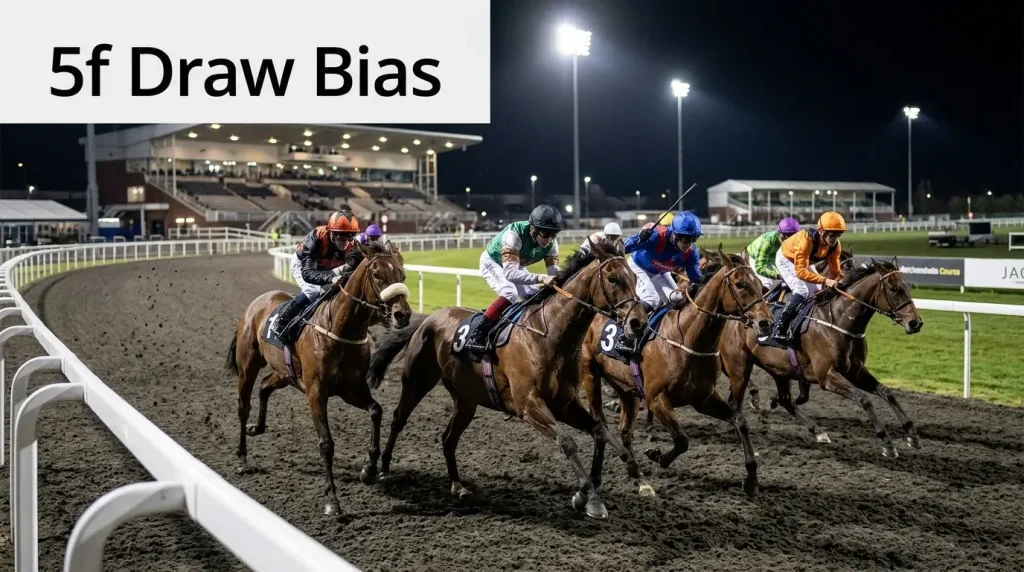
Wolverhampton 5f draw bias is the strongest distance-specific stall effect on any all-weather track in Britain. The combination of a starting chute that feeds almost immediately into a tight left-handed bend creates a structural advantage for horses drawn low — an advantage that is measurable, repeatable and, over five seasons of handicap data, demonstrably profitable.
This page is a single-distance deep dive. It covers the stall-by-stall data at 5f, explains the mechanical reasons why low draws win more often than the market prices them to, and shows how the draw interacts with pace style to produce the most actionable betting angle Wolverhampton has to offer.
Stall-by-Stall Performance at Five Furlongs
The data covers five seasons of handicap results at Wolverhampton over 5f, compiled from Sandracer’s draw-bias database. Each stall is assessed by win percentage, number of runners, actual-versus-expected ratio (A/E) and level-stakes profit (LSP) to a £1 stake.
Stalls one through four are consistently the most profitable positions. Stall one — the innermost berth, closest to the rail — has the shortest path around the first bend, and in large fields the positional advantage is immediate. A horse breaking cleanly from stall one at 5f can take the rail, save ground through the turn and establish itself in a prominent position before the field straightens. The A/E for low stalls across the sample period is comfortably above 1.0, meaning horses drawn low win more often than the market expects.
The middle stalls — five through eight — show mixed results. Some are marginally profitable, others are close to break-even. The variation reflects the fact that mid-drawn horses are neither disadvantaged by a wide berth nor guaranteed the rail. Their fate depends more on how the race unfolds: whether they can cross to the rail without using energy, whether the pace allows them to slot into a prominent position, and whether the jockey is experienced enough to manage the first bend from a neutral starting point.
High stalls — nine and above — are consistently negative at 5f. The further from the rail a horse starts, the more ground it loses on the first bend, and at 5f there is no time to recover. A horse drawn in stall twelve in a fourteen-runner handicap faces a measurable disadvantage before it has taken a stride. The LSP for high stalls across the sample is deeply negative, and the effect is amplified in larger fields where the congestion into the bend is most severe.
The overall picture is unambiguous. At 5f, low draws outperform high draws by a margin that is statistically significant and practically meaningful. This is not a marginal trend that might reverse with a few more data points. It is a structural feature of the course’s geometry, and it has been present across every season in the sample.
Front-runners in handicaps at this distance have produced a 35% recent win rate with an A/E of 1.48, returning a profit of 70p in the pound over six seasons. That pace-style edge compounds the draw effect: a low-drawn front-runner at 5f is working with two structural advantages simultaneously, and the combined edge is larger than either factor in isolation.
Why Low Draws Win at Five Furlongs
The explanation is geometric, not mysterious. The 5f start at Wolverhampton is from a chute on the back straight, and the field must negotiate a tight left-handed bend within the first furlong. The bend is sharper than at most all-weather tracks — tighter than Newcastle’s sweeping turns, tighter than Kempton’s long oval — and it creates a bottleneck effect in large fields.
Horses drawn low enter the bend on the inside line. They travel the shortest possible distance around the turn and can hold their position without having to angle across the track or lose momentum. Horses drawn in the middle must either push forward to get to the rail — using energy they will need later — or accept a wider path and cover more ground. Horses drawn high face the worst of it: they are forced wide around the turn, they cover extra lengths, and by the time the field straightens for the run to the line they have used more energy than the inside-drawn runners while being further back in the field.
Field size amplifies the effect. In a five-runner race, there is enough room on the track for every horse to find a position without interference, and the bend is not congested. In a fourteen-runner race, the field is compressed, the inside rail is at a premium, and the penalty for being drawn wide is compounded by the presence of other horses between you and the rail. This is why the draw data is strongest in big-field handicaps and weakest in small-field conditions races.
The kickback factor matters too. On Tapeta, horses running behind others receive a shower of surface material thrown up by the hooves in front. At 5f, where the field is tightly bunched through the bend, horses on the outside and behind the leaders cop the worst of this kickback. Some horses dislike it intensely and lose their action. A low draw minimises exposure to kickback because the horse is on the rail, in clean air, with the material being thrown away from rather than toward it.
Draw Plus Pace — The Combined Edge
The draw bias at 5f does not exist in isolation. It interacts directly with pace style, and the combination of the two factors produces the most profitable single angle on the course.
A front-runner drawn low at 5f has maximum advantage. It breaks from the inside stall, takes the rail, leads into the first bend and dictates the pace for the remainder of the race. In a truly run sprint, that positional advantage is often enough to hold off the closers, because the two-furlong home straight does not give hold-up horses enough time to make up the ground they have lost. Held-up favourites at 5f have returned a loss of 51p in the pound over the sample period — a figure that underlines just how difficult it is to come from behind at this distance on this track.
The legendary trainer and gambler Barney Curley once advised punters to have no fear betting on Tapeta, describing it as reliable and consistent — more practical than dirt and as dependable as turf. That consistency is exactly why the draw-and-pace pattern repeats itself so reliably at Wolverhampton. On a surface where the going barely changes and the footing is uniform from rail to stands, the geometric advantage of a low draw compounds race after race, season after season, without the interference of shifting ground conditions that would disrupt the pattern on turf.
The practical application is straightforward. When you see a 5f handicap on the Wolverhampton card with a field of ten or more, check two things: which horses are drawn in stalls one through four, and which of those have a front-running profile. The runners who tick both boxes are your shortlist. From there, assess trainer form, jockey booking and price. If the price offers value relative to the combined edge, you have a bet that is grounded in five years of data rather than in guesswork.
Wolverhampton 5f Draw Bias — More on this topic at wolverhampton race results.
See also How to Read Horse Racing Results.
