Dunstall Park Greyhound Stadium and Dual Fixtures
 Available in US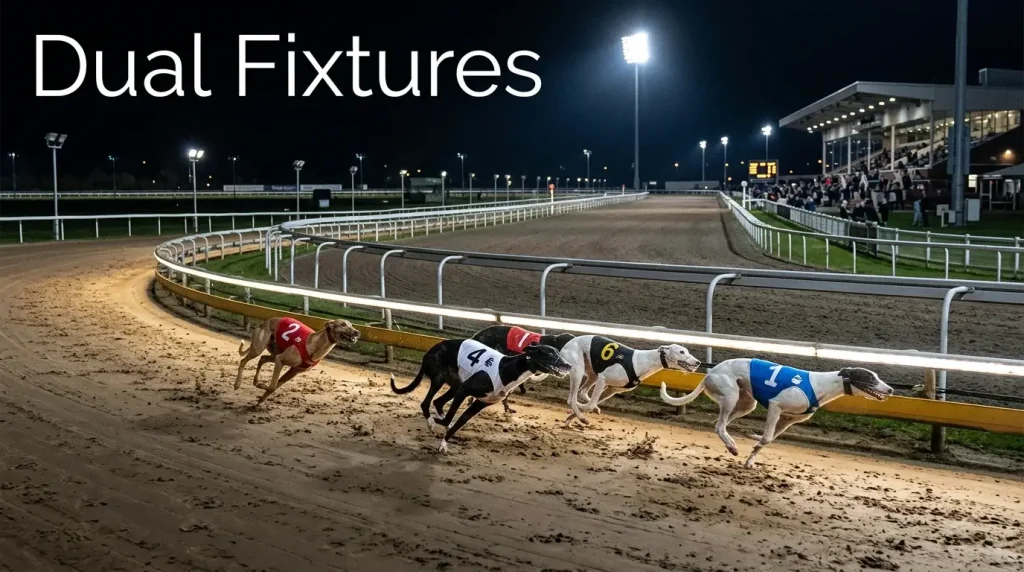
The Dunstall Park greyhound stadium opened on 19 September 2026 inside the Wolverhampton Racecourse oval — the first new purpose-built greyhound track in Britain since Towcester in 2014. Built within the contour of the existing horse racing circuit, it shares the racecourse’s infrastructure, facilities and audience, creating a dual-sport venue that is unique in British racing.
The project was part of Arena Racing Company’s £10 million investment programme at Wolverhampton, which also upgraded the grandstand, hospitality areas and wider venue facilities. The greyhound track is not a bolt-on afterthought — it was designed from the outset to operate alongside the horse racing programme, and on selected dates the two sports run simultaneously on the same ticket. That concept, tested for the first time on 7 March 2026, produced results that suggest it has a future well beyond a single trial. This page covers the greyhound stadium itself, the dual-fixture format and what both mean for the future of Dunstall Park.
The Track — Layout and Facilities
The greyhound circuit sits inside the horse racing oval, using the space enclosed by the Tapeta track. The layout was engineered to avoid any interference with the horse racing surface or sightlines, and the two circuits operate independently — horses race on the outer oval, greyhounds on the inner track. The design means both sports can run on the same day without either compromising the other.
The greyhound track itself is a standard-configuration oval suitable for racing over a range of distances. Facilities include a dedicated kennel block, parade area and mechanical hare system, all built to Greyhound Board of Great Britain (GBGB) standards. Spectator viewing is integrated with the existing racecourse grandstand, so racegoers can watch greyhound races from the same positions they use for horse racing — a practical detail that makes dual-fixture days feel seamless rather than disjointed.
The £10 million ARC investment funded the greyhound track construction alongside the broader venue modernisation. The financial logic is clear: a greyhound track inside an existing racecourse infrastructure shares overheads — parking, hospitality, staffing, marketing — rather than duplicating them. For ARC, which operates both horse racing and greyhound venues across Britain, Dunstall Park is a proof of concept for a model that could be replicated elsewhere if the economics work.
Capacity for standalone greyhound meetings follows the existing racecourse layout, meaning the venue can accommodate several thousand spectators depending on enclosure configuration. On dual-fixture dates, the combined attendance exceeds either sport’s standalone figures, which is the commercial rationale behind the concept.
The integration between the two tracks extends to the operational side as well. Ground staff, security, catering and betting services are shared across both codes of racing, which keeps costs manageable for the operator and ensures that dual-fixture dates do not require a dramatically expanded workforce. The result is a model that is commercially efficient as well as operationally practical — a venue that can run two sports simultaneously without doubling its overhead.
The First Dual Fixture — 7 March 2026
On 7 March 2026, Wolverhampton staged the first combined horse racing and greyhound racing fixture in British sporting history. The event was exactly what it sounds like: a full card of horse races on the Tapeta oval and a programme of greyhound races on the inner track, running on the same day, at the same venue, on a single admission ticket.
The result was emphatic. Footfall increased by 43% compared with the equivalent raceday twelve months earlier, and the atmosphere on course was noticeably different from a standard horse-only meeting. The audience included regular horse racing punters who had never watched greyhound racing, greyhound enthusiasts who had never attended a horse meeting, and a significant number of people drawn by the novelty of the dual format. Chris Black, general manager of the Dunstall Park Greyhound Stadium, described the strategy behind the concept: tapping into Wolverhampton Racecourse’s existing customer base and engaging more people with greyhound racing had always been a key part of the plan.
The scheduling was carefully managed. Horse races and greyhound races were interleaved rather than overlapping, so spectators could follow both codes without missing any action. In practice, this meant a horse race followed by a short interval, then a greyhound race, then another interval, then the next horse race — a rhythm that kept the energy high throughout the afternoon and evening. Betting was available on both sports, with on-course bookmakers offering prices on greyhound races alongside the standard horse racing service.
The media response was largely positive, with coverage focusing on the innovation and the commercial success rather than any operational difficulties. The 43% footfall increase was cited repeatedly as evidence that the concept has legs — and at a venue that already stages more than 80 horse racing fixtures a year, the addition of dual-fixture dates adds a new category of event that could attract audiences who might not otherwise visit Dunstall Park. For horse racing purists, the greyhound element is an optional extra that does not compromise the core product. For broader sports fans, it is a reason to come through the gates for the first time.
What Comes Next
The success of the March 2026 dual fixture makes it near-certain that further combined dates will follow. David Ideson, Wolverhampton’s executive director, called the event a real highlight in the racecourse’s 138-year history of hosting racing — language that signals intent to build on the concept rather than treat it as a one-off experiment.
The frequency of dual fixtures will depend on scheduling logistics, GBGB and BHA regulatory coordination, and commercial demand. A reasonable expectation is that Wolverhampton will stage between four and eight dual-fixture dates per year, concentrated in the winter months when the all-weather schedule is at its densest and the greyhound track can operate under the same floodlights that serve the horse racing circuit.
For horse racing punters, the dual-fixture format has marginal implications. The horse racing card is not affected by the greyhound programme — the races, distances, fields and surfaces are identical to any other Wolverhampton meeting. What changes is the atmosphere, the crowd size and the on-course betting dynamics. A busier ring can mean more accurate starting prices, and a larger crowd can create a more engaged environment that enhances the experience without altering the racing itself.
The greyhound racing element also opens a secondary betting interest for racegoers who want to stay active between horse races. On a standard evening card, the 25-to-35-minute gap between races can feel empty for punters who want continuous action. On dual-fixture dates, a greyhound race fills that gap, keeping the audience engaged and the betting ring active throughout the session. Whether you are interested in greyhound form or simply want a flutter between the 17:30 and the 18:00, the dual format provides it.
For Wolverhampton’s long-term positioning, the dual-fixture model represents something more significant than an entertainment novelty. It is a commercial strategy that diversifies the revenue base, attracts a broader audience, and positions Dunstall Park as a multi-sport venue rather than a single-code racecourse. Whether that model spreads to other ARC venues — or to racecourses operated by other groups — will depend on how the first full season of dual fixtures performs. The early signs, based on one data point and a 43% footfall uplift, are encouraging.
Dunstall Park Greyhound Stadium and Dual Fixtures — More on this topic at wolverhampton race results.
See also History of Wolverhampton Racecourse.
