
History of Wolverhampton Racecourse — 1825 to Present
 Available in US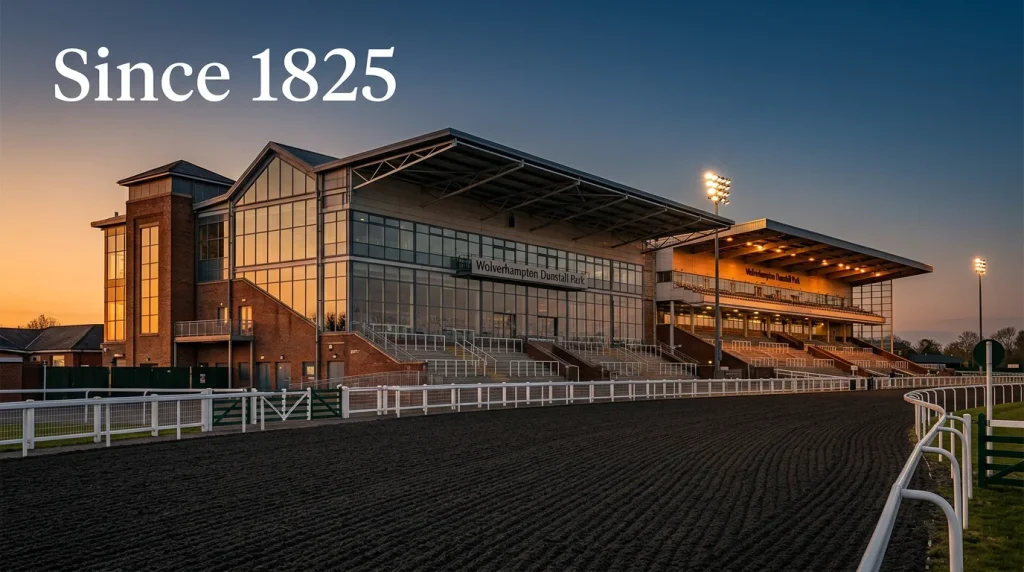
The Wolverhampton racecourse history spans nearly two centuries and tracks the evolution of a venue that has reinvented itself more often than almost any racecourse in Britain. From its origins as a modest turf track in the early 19th century to its current status as the busiest all-weather course in the country, Wolverhampton has been at the forefront of every major shift in British racing — floodlights, synthetic surfaces, dual-sport fixtures — and has survived periods that killed off less adaptable venues.
This is not a sentimental history. It is a timeline of decisions, investments and surface changes that directly shaped the track you bet on today. Understanding why Wolverhampton races on Tapeta, why it runs under floodlights, and why it stages 80-plus meetings a year requires knowing where those choices came from.
The Early Years — Victorian Turf Racing
The first recorded horse racing at Wolverhampton dates to 1825, on a course that bore little resemblance to the modern Dunstall Park. Early meetings were held on open land near the town, with flat turf racing attracting crowds from across the Black Country. The scale was modest — a handful of races on a handful of days each year — but the appetite for racing in the industrial Midlands was genuine and growing.
Dunstall Park itself opened as a dedicated racecourse in 1888, providing a permanent venue for Wolverhampton racing after decades of less formal arrangements. The site on Gorsebrook Road offered enough space for a proper circuit and the infrastructure — grandstand, enclosures, stable yards — that a late-Victorian racecourse required. The name Dunstall Park would become synonymous with Wolverhampton racing for the next 138 years and counting, surviving every subsequent transformation of the venue.
For the next century, Dunstall Park operated as a standard flat turf track, staging fixtures during the summer months and closing through the winter when the ground was unsuitable for racing. The turf era established Wolverhampton as a mid-tier flat course. It was never Newmarket or Ascot — the prize money was modest, the fields were local, and the prestige was limited. But it served its community, provided a venue for Midlands trainers and owners, and survived two World Wars, economic depressions and the gradual consolidation of the British racing calendar that closed less viable courses across the country.
By the late 20th century, Wolverhampton faced a familiar problem for smaller turf courses: limited racing days, limited revenue, and a venue that sat idle for half the year. The track needed to either find a way to race year-round or accept permanent irrelevance in a sport that was becoming increasingly concentrated in the hands of a few dominant venues. The solution — synthetic surfaces and floodlights — would transform Wolverhampton from an obscure turf track into one of the most important all-weather venues in the world.
The All-Weather Revolution — 1993 to 2014
In 1993, Wolverhampton installed a Fibresand surface and became one of the first all-weather tracks in Britain. The decision was driven by economics as much as innovation: a turf course that could only race for six months of the year was underutilising its assets, and a synthetic surface offered year-round racing regardless of weather. Fibresand — a sand-and-fibre composite — was the available technology, and Wolverhampton became a pioneer by adopting it.
The following year, in 1994, Wolverhampton became the first racecourse in Britain to stage racing under floodlights. Evening meetings under lights transformed the venue’s identity. Suddenly, Wolverhampton was not just an all-weather track — it was the evening racing track, the one that offered midweek entertainment after dark when every other racecourse had shut its gates. The floodlit evening card became Dunstall Park’s signature, and it remains so today.
Fibresand served Wolverhampton for over a decade, but it had limitations. The surface was deep and slow, favouring a particular type of horse and producing form that transferred poorly to other tracks. In 2004, Wolverhampton replaced Fibresand with Polytrack — a more advanced composite that offered better drainage, a faster surface and more consistent footing. The switch was part of a broader wave of Polytrack installations across British all-weather tracks, and it brought Wolverhampton’s surface in line with venues like Lingfield and Kempton.
The Polytrack era lasted a decade. In 2014, Wolverhampton replaced Polytrack with Tapeta, becoming the first track in Britain to install the surface. Tapeta — a blend of wax-coated sand, synthetic fibres and recycled rubber developed by Michael Dickinson — had been gaining traction internationally, particularly in North America, where its safety record and consistency had earned it a strong reputation. The switch was not without risk: replacing a functioning surface with an untested one is a significant decision for any racecourse. But Wolverhampton’s track record of early adoption — Fibresand in 1993, Polytrack in 2004 — made it a natural candidate for the next generation of synthetic technology.
The full surface chronology — Fibresand in 1993, Polytrack in 2004, Tapeta in 2014 — reflects a track that has been willing to adopt new technology at every stage, staying at the leading edge of surface science rather than waiting for others to prove the concept. Each transition reshaped the form book: horses that thrived on Fibresand did not always adapt to Polytrack, and the shift from Polytrack to Tapeta produced another round of surface-preference reshuffling. For form students, these transitions are important historical context — form figures from the Polytrack era do not transfer directly to the current Tapeta track, and treating pre-2014 Wolverhampton form as equivalent to post-2014 form is a mistake.
The Tapeta era has been the most stable. Twelve years on the same surface has generated a deep and consistent dataset that rewards analytical approaches — draw bias, pace bias and trainer patterns have had time to establish themselves across thousands of races, and the patterns are robust enough to be used as betting filters with genuine confidence. That stability is itself a legacy of the 2014 decision to install Tapeta, and it is one of the reasons Wolverhampton’s data is more actionable than that of courses which have changed surface more recently.
The Modern Era — 2026 and Beyond
The most recent chapter in Wolverhampton’s history began with the completion of Arena Racing Company’s £10 million investment programme in 2026. The investment covered a comprehensive modernisation of the grandstand, hospitality suites, bars, restaurants and wider venue infrastructure. The centrepiece was the construction of the Dunstall Park Greyhound Stadium inside the horse racing oval — a purpose-built greyhound track that opened in September 2026, the first new greyhound venue in Britain since Towcester in 2014.
The dual-sport concept was tested on 7 March 2026, when Wolverhampton hosted the first combined horse racing and greyhound racing fixture in British sporting history. Footfall rose by 43% compared with the equivalent date the previous year. David Ideson, the racecourse’s executive director, described the event as a real highlight in Dunstall Park’s 138-year history of hosting racing.
The 2026 season also brought the 25th running of the Lady Wulfruna Stakes, Wolverhampton’s only Listed race, carrying a prize fund of £60,000 — a marker of how far the track has come from its days as a modest turf venue with limited ambitions. The Lady Wulfruna has become part of the national racing calendar, attracting runners from major yards and serving as a centrepiece of the All-Weather Championships season.
Looking ahead, Wolverhampton’s position as the busiest all-weather track in Britain appears secure. Its fixture count exceeds 80 meetings per year, its Tapeta surface is proven, its floodlights enable evening racing that no other UK venue has matched in volume or consistency, and the dual-fixture model opens a new revenue and audience stream. The course that started as a Victorian turf track has transformed itself into something its founders could not have imagined — and the transformation is still underway.
The numbers tell the story of that transformation more plainly than any narrative. In 2026, British racecourses collectively drew 5.031 million visitors — the first time attendance surpassed five million since before the pandemic. Wolverhampton contributes around 120,000 of those visitors annually across racing, events and conferences. A track that once risked obsolescence as a minor turf venue now generates footfall that rivals many of the country’s established flat-racing heartlands.
That willingness to evolve is Wolverhampton’s defining trait. From Fibresand to Polytrack to Tapeta, from daytime turf to floodlit all-weather, from horse-only venue to dual-sport destination — each step was a bet on the future, and each one has paid off. The next chapter will be written by the same logic: identify what works, invest in it, and stay ahead of the field. For a racecourse, that is a strategy worth backing.
History of Wolverhampton Racecourse — More on this topic at wolverhampton race results.
See also UK All-Weather Racing Explained.
