
UK All-Weather Racing Explained — Surfaces, Seasons and Stats
 Available in US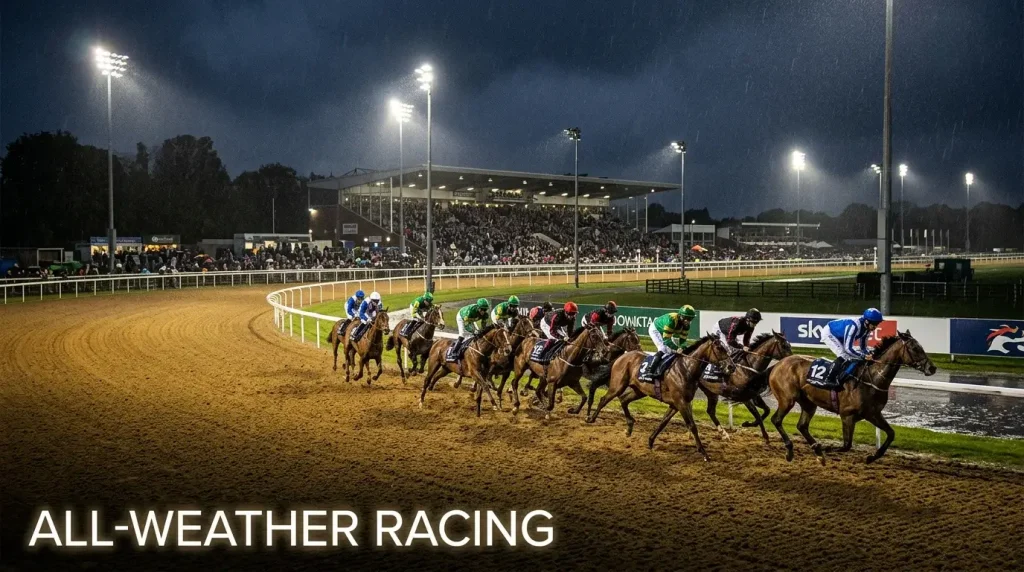
All-weather racing in the UK keeps flat racing alive when the turf season contracts. Six tracks across England stage racing on synthetic surfaces year-round, providing fixtures, fields and betting markets through the winter months when waterlogged or frozen turf courses would otherwise shut the sport down. For punters who follow the flat, all-weather racing is not a sideshow — it is where the action moves from October to April, and increasingly where data-driven analysis finds its richest ground.
This page explains what all-weather racing is, how it differs from turf racing, which tracks host it, what surfaces they use, and why field sizes and quality have reached their highest levels in nearly two decades. If Wolverhampton is your primary focus, this is the wider context that the track sits within. Understanding the all-weather ecosystem as a whole — its economics, its surface differences and its competitive structure — makes you a sharper analyst of any individual race at Dunstall Park.
What Is All-Weather Racing?
All-weather racing is flat horse racing staged on synthetic surfaces designed to withstand rain, frost and drought without becoming unraceable. The concept was introduced to Britain in the early 1990s as a direct response to the limitations of turf: traditional grass courses can only race when the ground is safe, which means lost fixtures in winter, abandoned meetings after heavy rain, and a racing calendar that contracts precisely when the betting market is looking for product.
Synthetic surfaces solve that problem. They drain efficiently, maintain consistent footing regardless of weather, and allow racing to take place under floodlights in the evenings — something turf courses rarely attempt. All-weather flat racing operates under the same BHA rules as turf racing: the same licensing, the same weight-for-age scale, the same handicapping system, the same jockey and trainer regulations. The differences are in the surface, the schedule and — to a degree — the class profile of the horses. But the betting markets work identically, the form book is compiled in the same way, and the analytical tools that serve turf punters serve all-weather punters just as well — often better, because the consistency of the surface removes one of the biggest variables in turf form.
All-weather races do not include jumps racing. National Hunt racing — hurdles and steeplechases — remains exclusively on turf in Britain, with courses built specifically for jumping. The all-weather programme is flat-only, covering distances from 5f to 2m, though the overwhelming majority of AW races are sprints and middle-distance events between 5f and 1m4f. This flat-only restriction means the all-weather calendar serves a specific segment of the training population: flat horses, often those who do not handle soft winter turf, benefit from a surface that allows them to race competitively through the colder months without waiting for the spring.
The economics of all-weather racing have improved steadily since its introduction. Prize money, while still lower than at top turf fixtures, has risen at every level. The All-Weather Championships series provides a prestige pathway that did not exist in the early years of synthetic racing, and the collective prize fund for the series — anchored by a £1 million Finals Day — gives trainers a reason to campaign their better all-weather horses rather than simply marking time until the turf season resumes.
The class spectrum on the all-weather is broad. It ranges from Class 7 maiden races for unraced horses at the bottom to Listed events like the Lady Wulfruna Stakes at Wolverhampton near the top. There are no Group races on all-weather in Britain — Group 1, 2 and 3 events are restricted to turf — but the Listed-level and championship pathway gives all-weather racing a competitive structure that extends well beyond filling the winter calendar.
The Six All-Weather Tracks
Britain has six all-weather racecourses, each with a different surface, track geometry and character. Between them, they stage more than 200 fixtures per season as part of the All-Weather Championships calendar, plus additional meetings outside the championship framework.
Wolverhampton races on Tapeta — a wax-coated sand and synthetic fibre composite — and is the busiest of the six, staging 80-plus fixtures annually under floodlights. The track is a tight, left-handed oval of approximately one mile circumference, and its geometry creates the most pronounced draw bias of any AW course in the country. Newcastle, the other Tapeta track, is a galloping, left-handed circuit with longer straights and gentler bends — a very different racing proposition despite sharing the same surface.
Lingfield, Kempton and Chelmsford all race on Polytrack, the most common all-weather surface in Britain. Lingfield is left-handed and sharp, with a pronounced downhill run to the straight. Kempton is a flat, right-handed triangle that favours prominently ridden horses on its long straight. Chelmsford is a modern, left-handed oval designed to produce fair racing with minimal draw bias. Each Polytrack venue rides slightly differently, which means form from one does not transfer automatically to another.
Southwell was historically the outlier on Fibresand — the oldest all-weather surface in Britain — but switched to Tapeta in 2021. That change brought Southwell’s surface in line with Wolverhampton and Newcastle, making cross-form comparisons between the three Tapeta venues more reliable than in the Fibresand era. However, Southwell’s track geometry and going characteristics remain distinct, so form does not transfer identically. Punters who relied on the old Fibresand approach need to recalibrate: Southwell’s Tapeta rides faster and demands different physical attributes from horses than the heavy, stamina-sapping surface it replaced.
The diversity of surfaces across the six tracks is both a challenge and an opportunity. It means you cannot treat all-weather form as a monolith — a win at Lingfield on Polytrack does not carry the same weight at Wolverhampton on Tapeta as a win at Wolverhampton itself. But it also means that cross-surface analysis — identifying which horses transfer form between venues and which do not — is a genuine edge for punters willing to do the work. The detailed comparison of all six tracks is covered in the course-comparison page elsewhere on this site.
Field Sizes, Quality and the Safety Case
All-weather racing in Britain has been growing in both volume and quality. During January and February 2026, 73% of AW flat races attracted fields of eight or more runners — the highest proportion since 2007 and a figure that reflects increasing trainer confidence in the surfaces and the prize money on offer. Bigger fields mean more competitive betting markets, sharper form lines and more reliable data for analytical approaches like draw-bias and pace-bias modelling.
The quality of AW racing has also improved. The All-Weather Championships series, with its £1 million Finals Day, provides a prestige pathway that did not exist when synthetic racing was introduced in the 1990s. Top trainers now target AW fixtures as part of structured campaigns rather than using them as gap-fillers between turf engagements. The result is stronger fields, better prize money and a product that attracts serious betting interest rather than being treated as a poor relation to turf.
The safety record of synthetic surfaces strengthens the case further. Lisa Lazarus, CEO of the Horseracing Integrity and Safety Authority in the United States, has publicly commended the prioritisation of horse safety through all-weather surface adoption — a view that reflects the international consensus that synthetic tracks produce fewer catastrophic injuries than turf or dirt. In Britain, the BHA’s own data supports the same conclusion: all-weather surfaces are safer for horses than traditional surfaces, which in turn supports the case for maintaining and expanding the AW programme.
For Wolverhampton punters, the macro trend is positive. More fixtures, bigger fields, better-quality racing and safer surfaces combine to create an environment where data-driven analysis can thrive. The all-weather calendar is not a winter necessity to be endured — it is a distinct racing ecosystem with its own form dynamics, its own specialists and its own edges. Understanding it on its own terms, rather than treating it as a pale imitation of the turf, is the first step toward betting on it profitably.
The growing international embrace of synthetic surfaces adds a further dimension. In the United States, NYRA has committed to all-Tapeta winter racing at Belmont Park from 2026, and tracks in Canada, Australia and Japan have adopted or trialled synthetic surfaces for similar safety and consistency reasons. This global trend generates an expanding body of data on how horses perform on synthetics, which in turn enriches the analytical toolkit available to anyone betting on all-weather racing in Britain. What was once a niche sector of British racing is becoming a global movement — and Wolverhampton, as the busiest AW venue in the UK, sits at the centre of it.
UK All-Weather Racing Explained — More on this topic at wolverhampton race results.
See also British Horse Racing Industry.
