
Wolverhampton SP and Starting Price Explained
 Available in US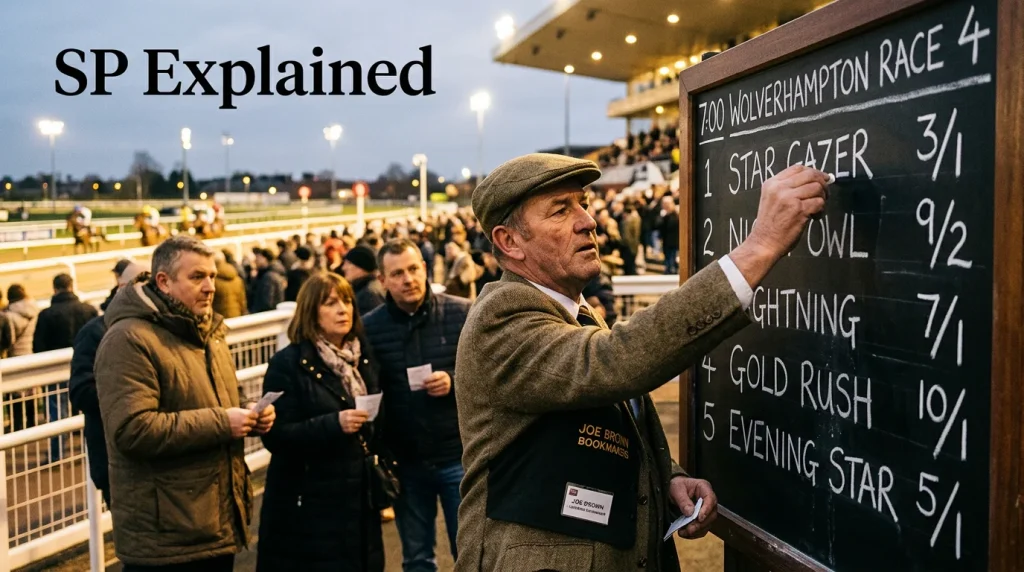
The Wolverhampton starting price is the official odds returned for every runner at the moment the stalls open. If you bet at SP — or if your bookmaker settles your bet at the returned starting price — then this number determines your payout. It is also the benchmark figure recorded in every race result, the number that appears alongside finishing positions in the form book, and the reference point that drives level-stakes profit calculations for every analytical model built around Wolverhampton data.
Understanding how the SP is formed, why it can differ from exchange prices, and what it tells you about the market’s view of a horse is foundational knowledge for anyone who bets on racing at Dunstall Park. This page explains the mechanics from the ground up.
How the Starting Price Is Determined
The SP is compiled by a team of independent starting price reporters employed by the BHA. These reporters stand in the on-course betting ring at every British racecourse and record the prices offered by on-course bookmakers in the final moments before the race begins. The SP for each horse is the consensus price available from the on-course bookmakers at the off — not the best price, not the worst, but a representative reading of what the ring was offering.
The process is straightforward in principle but nuanced in practice. On-course bookmakers set their own prices based on the money they are taking. If a horse attracts heavy support in the ring, its price shortens; if nobody backs it, its price drifts. The SP reflects the aggregate of these individual adjustments across multiple bookmakers. At a busy Saturday turf meeting, a dozen or more bookmakers might be offering prices, and the SP is a reliable representation of market sentiment. At a midweek Wolverhampton evening meeting, the ring is smaller — perhaps four to six bookmakers — which means the SP is formed from a thinner pool of opinions.
That thinness matters. When fewer bookmakers are competing, the prices can be wider, the margins less sharp, and the SP less reflective of the broader market’s view. A horse that would return at 3/1 SP at a big Saturday turf meeting might return at 5/2 or 7/2 at an evening Wolverhampton fixture, simply because the on-course ring priced it differently from the fixed-odds and exchange markets. This discrepancy is a feature of the SP system rather than a flaw, but it is one that Wolverhampton bettors need to understand.
The SP reporters operate under a code of practice overseen by the BHA. Their role is to record, not to influence — they are observers, not market makers. The integrity of the SP system depends on the independence and accuracy of these reporters, and while the system has faced occasional criticism over the years, it remains the universal settlement mechanism for SP bets across all licensed bookmakers in Britain.
SP Versus Exchange Price Versus Early Fixed Odds
The SP is one of three prices you might encounter for the same horse at the same meeting. The other two are the early fixed odds — offered by online bookmakers from the morning show onward — and the exchange price, typically on Betfair, which is determined by supply and demand between individual bettors.
Early fixed odds are available hours before the race and lock in a price at the time of your bet. If you back a horse at 5/1 at 10:00 and the SP returns at 3/1, you are paid at 5/1 — you captured value by betting early. If the SP returns at 8/1, you took a shorter price than you needed to. Early-price betting rewards conviction: if your analysis tells you a horse is likely to shorten, taking the morning price is the optimal play.
The Betfair starting price (BSP) is calculated from the exchange order book at the moment the race begins. At Wolverhampton evening meetings, where exchange liquidity is lower than at major turf fixtures, the BSP can differ noticeably from the on-course SP. British racing’s total betting turnover fell by 6.8% in 2026, and the decline has been most acute outside the premier-fixture bracket — which means exchange liquidity at midweek AW meetings is thinner than it was a few years ago. BSP at Wolverhampton can be generous when the exchange pool is small, but it can also be volatile.
The choice between SP, fixed odds and exchange depends on your betting style and your confidence in the selection. For a well-researched pick that you believe will shorten, take the early fixed price. For a speculative bet where you are less certain, SP removes the need to time the market. For a value-focused approach that aims to exploit thin evening markets, the BSP on Betfair can offer structural advantages — but only if you are comfortable with the exchange model and the commission structure.
What the SP Tells You in the Result
Every Wolverhampton result lists the SP alongside each horse’s finishing position. That number is a compressed summary of the market’s pre-race assessment. A winner at 6/4 was the market’s pick — the favourite or close to it. A winner at 14/1 was largely unconsidered. A winner at 200/1, as Dandy Flame demonstrated at Wolverhampton in 2016, was so far outside the market’s calculations that the result effectively constituted a system failure from the bookmakers’ perspective.
The relationship between SP and finishing position tells you about the market’s accuracy. If favourites are winning at their expected rate — roughly 30% to 33% of the time — the market is functioning normally. If favourites are significantly underperforming over a period at a specific course, it may indicate that the market is mispricing certain factors — draw bias, pace bias or trainer form — that a more informed punter can exploit.
For form study, the SP of beaten horses is as informative as the SP of the winner. A horse that finishes second at 20/1 was not fancied but ran well — its next start, if at a similar level, may offer value because the market has not yet adjusted to its improved form. A horse that finishes last at 6/4 was the market’s pick and failed — which raises questions about whether the form is reliable, the going was unsuitable, or the draw was unfavourable.
At Wolverhampton, where the going is consistent and the surface does not change, the SP-form relationship is particularly stable. A horse’s SP at its last Wolverhampton start is a useful proxy for the market’s view of its ability at this specific track, and tracking how that price moves between starts — shorter, drifting, or stable — adds an extra dimension to your pre-race analysis. A horse that ran at 8/1 SP last time and opens at 5/1 this time has attracted money, which may reflect improved training reports, a better draw, or a change in connections. A horse that drifts from 4/1 to 8/1 may have lost support for reasons the form does not immediately show.
The price is not just a number. It is a summary of everything the market thinks it knows, and at Wolverhampton, the things the market misses — draw, pace, connections — are precisely where the value hides. Learning to read the SP in context, as part of a wider analytical framework rather than in isolation, is what transforms a casual punter into a systematic one.
Wolverhampton SP and Starting Price Explained — More on this topic at wolverhampton race results.
See also Wolverhampton Trainer Statistics.
