
Lady Wulfruna Stakes — History, Winners and 2026 Preview
Best Horse Racing Betting Sites – Bet on Horse Racing in 2026
Loading...
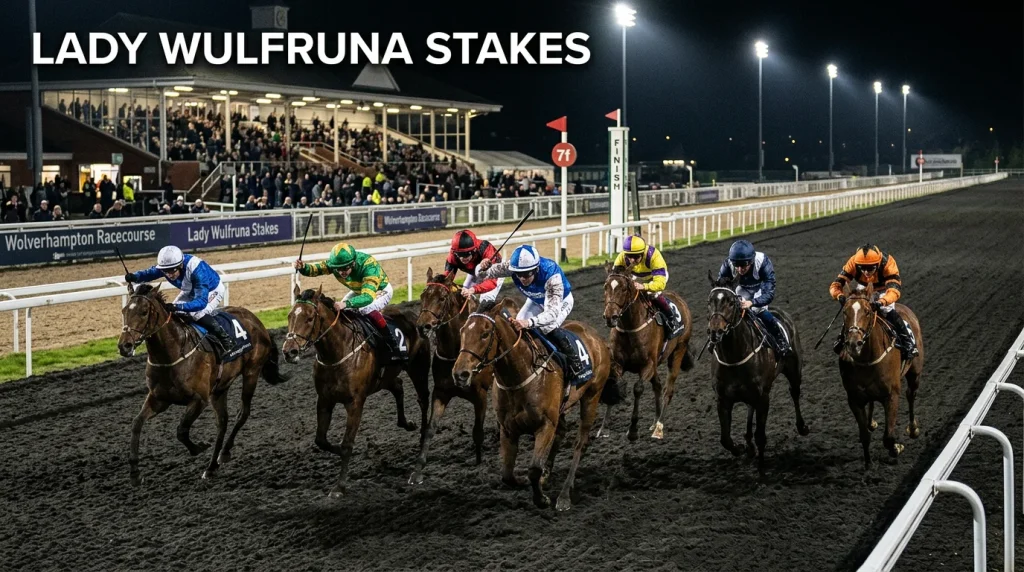
The Wolverhampton Lady Wulfruna Stakes results tell the story of Dunstall Park’s only Listed race — a 7f 36y contest that has served as the track’s flagship event for a quarter of a century. The 2026 renewal is the 25th running, carrying a prize fund of £60,000, and it represents the one fixture each year when Wolverhampton steps out of its all-weather workhorse role and stages something that belongs on the national racing calendar.
Named after Lady Wulfruna, the Anglo-Saxon noblewoman who founded the city of Wolverhampton in 985 AD, the race has carved out a distinct identity within British racing. It is the highest-graded flat race ever staged at Dunstall Park, and over two decades it has attracted runners from some of the most powerful yards in the country — connections who would not normally target a midweek all-weather meeting but who recognise the value of a Listed prize on Tapeta in the spring.
Below is a full profile of the race, a look at past winners and the patterns they reveal, and a preview of what the 25th running might produce. If you bet on this race, or if you simply want to understand what makes it different from the standard Wolverhampton card, this is where to start.
Race Profile — Distance, Conditions and Standing
The Lady Wulfruna Stakes is a Listed flat race, open to horses aged four and upwards, run over a distance of 7f 36y on Tapeta. Listed status sits one rung below Group 3 in the pattern race hierarchy — it is not a Group race, but it is a black-type event, which means a winner’s pedigree page carries the result in bold. For breeders and owners, that distinction has genuine commercial value beyond the prize money itself.
The 7f 36y distance is specific to this race and does not appear on the standard Wolverhampton fixture card. Standard 7f races at Dunstall Park are run over 7f exactly; the extra 36 yards in the Lady Wulfruna reflects a unique start position that alters the tactical shape of the contest. The additional distance means the field has marginally more time to settle before the first bend, which can benefit horses who are drawn wide or who need a furlong to find their stride. It also means that pure speed horses — the kind that dominate 5f and 6f — may find the distance just stretching them, while confirmed milers may find it sharp enough to put a premium on tactical pace.
Entry criteria are straightforward: the race is restricted to horses aged four and over, with a penalties-and-allowances structure that gives recent winners an additional weight burden and allows unexposed types to run at a lower mark. In practice, the field typically numbers between eight and twelve runners — smaller than a big-field handicap but large enough for draw-bias data to be relevant.
The Lady Wulfruna occupies a specific slot in the All-Weather Championships calendar, usually falling in March. It serves as a late-season showcase, often attracting horses who have accumulated AWC qualifying points through the winter and are looking for a pattern-race credential before the turf season begins. For trainers, it is one of the last meaningful all-weather targets before the emphasis shifts to turf from April onward.
Prize money has grown steadily over the race’s history. The £60,000 pot for 2026 is the most valuable in the race’s existence, reflecting both inflation and the BHA’s commitment to improving prize funds at all-weather fixtures. By comparison, a standard Class 4 handicap at Wolverhampton might offer £6,000 to £8,000 — so the Lady Wulfruna carries roughly eight to ten times the prize of an ordinary midweek card race.
Past Winners and Patterns
Two decades of Lady Wulfruna results reveal patterns that are worth knowing before you assess the 2026 renewal. The race has not been dominated by a single trainer or jockey in the way that some all-weather leaderboards are, but a handful of themes recur often enough to be meaningful.
First, pace matters at 7f 36y — but not in the same way it matters at 5f. The Lady Wulfruna is typically run at a genuine gallop, because the quality of the field is higher than a standard handicap and the riders are experienced enough to set a tempo that suits their horse. Front-runners have won the race, but so have hold-up horses who timed a late challenge to perfection. The difference from shorter distances is that the pace bias is less structural and more dependent on the individual renewal. A year with two confirmed front-runners in the field produces a different tactical setup from a year with none.
Second, the draw at 7f at Wolverhampton carries a different profile from the draw at 5f or 6f. The five-season stall data shows that stall 9 at 7f has been the most unprofitable position on the course, returning a level-stakes loss of −287.42 points. But the Lady Wulfruna’s 7f 36y distance, with its slightly extended start position, modifies the effect. The extra 36 yards gives wide-drawn horses marginally more time to negotiate the first bend without losing as much ground. In a Listed field of eight to twelve runners — smaller than a typical handicap — the draw effect is present but not as severe as it would be in a fourteen-runner 6f sprint.
Third, trainers who specialise in all-weather racing have produced a disproportionate share of winners. This makes intuitive sense: the Lady Wulfruna rewards horses with proven Tapeta form, and trainers who run regularly at Wolverhampton know the track, the surface and the tactical requirements better than those who appear once a year for the big race. It is not a guarantee — outsiders have won — but it is a filter worth applying when you assess the entries.
Starting prices of past winners have ranged from short-priced favourites to double-figure outsiders. The race is competitive enough that the market does not always get it right, and the betting tends to be more open than the form book might suggest. A Listed field attracts sharper analysis from professional punters, which means the overround is tighter and the prices are generally more efficient — but there is still room for value, particularly if you can identify a runner whose Tapeta form has been underrated by turf-centric form students.
Notable past winners include horses who went on to compete at Group level on turf, using the Lady Wulfruna as a springboard. Others were confirmed all-weather specialists who treated the race as their annual crowning moment. Both types can win, and the distinction between them matters for what comes next: a turf-bound improver may offer less value on the day but more in subsequent races, while a confirmed AW specialist may be at peak value in this specific contest.
The 25th Running — 2026 Preview
The 2026 Lady Wulfruna Stakes carries the weight of a milestone. Twenty-five renewals of any race creates a history worth celebrating, and Wolverhampton has used the occasion to build the event into a centrepiece of the spring calendar. David Ideson, the racecourse’s executive director, described the first dual horse-and-greyhound fixture in March 2026 as a real highlight in Dunstall Park’s 138-year history of hosting racing — and the Lady Wulfruna, whether or not it falls on a dual-fixture date, sits at the heart of that identity.
The 25th running also coincides with a period of investment and renewal at the racecourse. The £10 million programme completed by Arena Racing Company has upgraded facilities across the site, and the opening of the Dunstall Park Greyhound Stadium in September 2026 has added another dimension to the venue. For connections bringing a runner to the Lady Wulfruna, the experience is noticeably different from the Wolverhampton of a decade ago — better viewing, better hospitality, and a venue that increasingly positions itself as an events destination rather than just a racing circuit.
From a betting perspective, the 2026 renewal is likely to attract a field that reflects the growing quality of the All-Weather Championships pathway. Horses who have accumulated points through the winter may use the Lady Wulfruna as a final statement before Finals Day on Good Friday. Trainers with strong Wolverhampton records — yards that have dominated the Dunstall Park leaderboard across five seasons — will have an inherent advantage in a race where course knowledge and Tapeta form matter more than raw ability.
The draw will matter, the pace will matter, and the surface will be as consistent as it always is. What makes the Lady Wulfruna different from the other 500-odd races staged at Wolverhampton each year is the quality of the field and the significance of the result. A horse that wins this race earns more than prize money — it earns a line of black type that follows it for the rest of its career. For punters, the challenge is the same as ever: find the horse whose profile fits the race, at a price that represents value. The 25th running will reward the same discipline that every Wolverhampton race rewards — just at a slightly higher level.