
Wolverhampton Evening Racing — Night Meetings Under Floodlights
Best Horse Racing Betting Sites – Bet on Horse Racing in 2026
Loading...
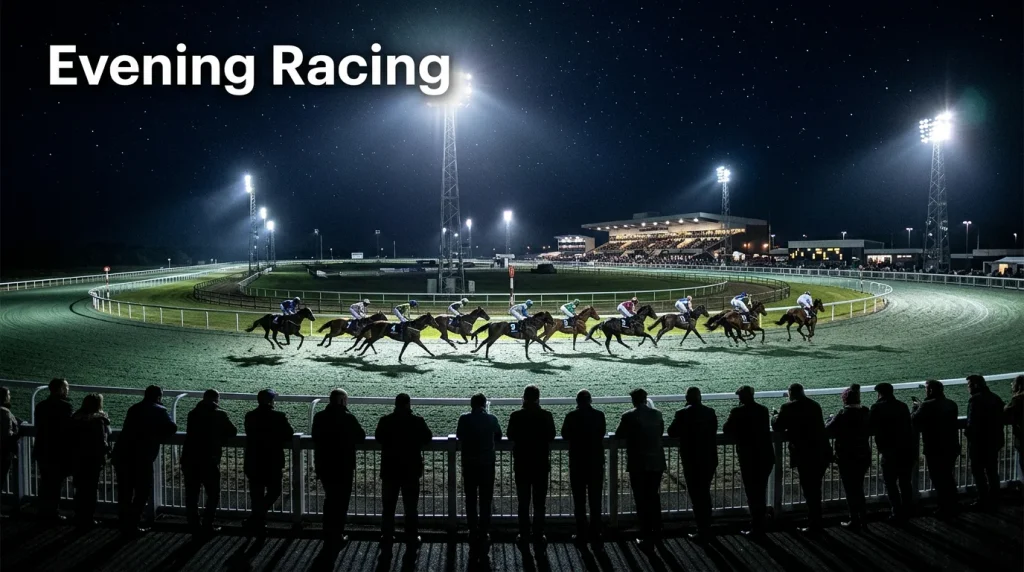
Wolverhampton evening racing is the heartbeat of Dunstall Park. When the floodlights come on — as they have done since the course pioneered night racing in Britain in 1993 — Wolverhampton transforms from a racecourse into something closer to a sporting arena. The majority of the track’s 80-plus annual fixtures are evening cards, staged under lights that turn the Tapeta surface into a glowing strip against the West Midlands night.
For punters, evening meetings are not just a scheduling quirk — they carry specific characteristics that affect the betting market, the quality of the fields and the atmosphere on course. For racegoers, they offer a different experience from daytime racing: more intimate, more concentrated, and more accessible for anyone who works a standard day. This page covers what makes Wolverhampton’s evening programme distinctive and how to approach it, whether you are betting from home or heading through the gates.
The Evening Schedule — Timing and Frequency
A typical Wolverhampton evening card begins between 16:30 and 18:00, depending on the time of year and the number of races. Winter cards — November through February — tend to start earlier, around 16:30 or 17:00, to accommodate shorter daylight hours and allow the full programme to finish by 20:30. Summer evening fixtures may start as late as 18:00 or 18:30, finishing around 21:00.
The standard card carries six or seven races, spaced at intervals of approximately 25 to 35 minutes. That rhythm gives punters enough time between races to review the form for the next, check the market, and decide on a position — without the rushed turnaround that some dense afternoon programmes impose. For on-course visitors, the intervals are long enough to eat, drink and watch the horses in the parade ring without feeling hurried.
Evening meetings dominate the winter schedule overwhelmingly. During the core all-weather season, Wolverhampton may stage two evening cards in a single week, with only occasional afternoon fixtures breaking the pattern. This changes in summer, when afternoon and twilight slots become more common as the fixture list thins and turf racing takes priority. But even in July and August, Wolverhampton maintains a presence on the evening circuit that no other AW track matches.
The frequency matters for form study. A horse that runs at a Monday evening meeting may appear again on the following Thursday or Saturday. Trainers who campaign horses at Wolverhampton during the winter can slot them into the next available card within days, and many do. That quick turnaround creates a tightly woven form picture where each meeting’s results feed directly into the next set of declarations — a data loop that rewards bettors who pay attention to the schedule rather than dipping in at random.
Betting at Evening Meetings — Markets, Odds and Value
Evening meetings at Wolverhampton sit in a specific bracket of the betting ecosystem. They are not the headline fixtures that attract the heaviest turnover — that status belongs to Saturday afternoon Group races on the turf, where the big-staking customers concentrate their activity. British racing’s total betting turnover fell by 6.8% in 2026, and the decline has been felt most acutely outside the premier-fixture bracket. Evening all-weather meetings at tracks like Wolverhampton sit firmly in the “core” category, where lower liquidity is the norm.
Lower liquidity has practical consequences. The on-course betting ring at an evening Wolverhampton meeting is smaller than at a major daytime fixture, which means fewer bookmakers competing for your business and potentially wider margins in the prices they offer. The starting price, compiled from the on-course ring, may not reflect the true probability of a horse winning as accurately as it would at a busier meeting. Exchange markets are thinner too, particularly for races that go off after 19:00 — the pool of money available on Betfair at 19:30 on a Tuesday evening is a fraction of what you would find at Ascot on a Saturday afternoon.
That thinness can work in your favour. When the market is less efficient, mispricing is more likely. A horse whose draw-bias profile suggests a 25% chance of winning may be available at 5/1 — implying a 17% chance — because the market has not incorporated the stall data as precisely as a deeper pool would. That gap is where value lives, and it appears more frequently at evening all-weather meetings than at higher-profile fixtures where the market is better informed.
Class levels at evening meetings tend to cluster between Class 4 and Class 6, with occasional Class 3 events. The horses are generally exposed — they have run enough times for their ability to be assessed — and the form lines connecting them are often dense because they race frequently at the same venue. This density makes evening Wolverhampton meetings one of the more analysable betting propositions in British racing. You may not have the depth of market that a Grade 1 hurdle commands, but you have a depth of data that compensates.
One additional consideration: evening meetings attract a higher proportion of casual bettors relative to professionals, partly because of the accessible timing and the lower stakes involved. A midweek evening punter may be placing a £5 or £10 bet for entertainment after work, not running a professional trading operation. The combined effect of casual money in a thin market can produce price distortions that serious form students can exploit.
Attending an Evening Meeting at Dunstall Park
If you have never been to Wolverhampton for an evening card, the experience is different from daytime racing in ways that go beyond the obvious fact that it is dark. The floodlights create a contained, almost theatrical atmosphere — the focus is narrowed to the track, the stands and the paddock, with the surrounding city fading into the background. It feels more like a sporting event and less like a day at the races.
Dress codes are relaxed. Smart casual is the standard across most enclosures, and there is no expectation of the formal attire that some turf courses still require. This is one of the reasons evening meetings attract a younger, more diverse crowd than many traditional racedays — the barriers to entry are lower, both in dress and in cost.
Dining options range from casual bars and fast food to sit-down restaurant bookings in the hospitality areas. The £10 million investment by Arena Racing Company has upgraded the on-course facilities significantly, and the standard of the bars and restaurants is noticeably higher than it was five years ago. If you are making an evening of it rather than just popping in for a couple of races, the hospitality packages are competitive with other AW venues.
Getting home after an evening meeting is straightforward if you have driven — the 1,500-space car park means you will not be queuing to leave for long. For those using public transport, Wolverhampton railway station is approximately two miles away, and taxis are readily available. The one thing to check is the late-evening train schedule: if the last race finishes at 20:30 and you need a connection from Wolverhampton station, confirm the departure time before you travel. Services on some routes become infrequent after 21:00, particularly midweek.