
Wolverhampton Results Today — Latest Races and Finishing Order
Best Horse Racing Betting Sites – Bet on Horse Racing in 2026
Loading...
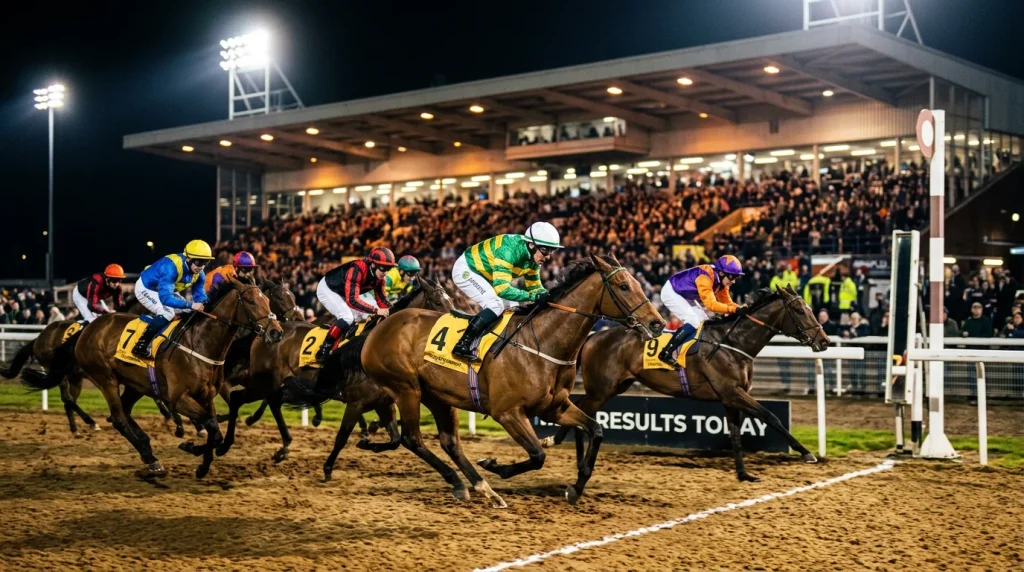
Wolverhampton results today are updated after every race at Dunstall Park, giving you finishing positions, starting prices and official distances as soon as the judge confirms. Whether the card runs in an afternoon slot or — more often — under the floodlights that have defined this course since 1993, you will find the full finishing order here without waiting for the morning papers.
Dunstall Park stages more than 80 fixtures a year, making it the busiest all-weather venue in the country. That volume matters. It means there is almost always a recent result to check, a trend to track, or a race to replay. Monday-night handicaps, midweek novice cards, Saturday afternoon features — the fixture list barely pauses. For punters who follow Tapeta form, that steady rhythm creates a rolling data set that rewards attention. The surface itself has been in place since 2014, and Wolverhampton’s left-handed oval, run entirely under floodlights, produces form lines that are distinct from any other British track.
Below you will find the full race-by-race results for the current or most recent Dunstall Park meeting, plus the going report, any notable non-runners and a pointer toward what comes next on the calendar. If the meeting is still live, results are added race by race as they become official. Each result includes the finishing order, starting price, official distances and the winning trainer-jockey combination — the core data points that feed into any serious form analysis on this track.
Race-by-Race Results From Dunstall Park
Each race listed below follows a standard format: race time, race name, class, distance and going are shown first, followed by the finishing order with starting price, distance beaten and the winning trainer-jockey combination. All positions are taken from the official judge’s result.
How to Read the Result Lines
The finishing position is self-explanatory. The starting price (SP) is the on-course price returned at the off — it may differ from the best odds available earlier in the day, particularly at evening meetings where liquidity on betting exchanges tends to be thinner. Distances are expressed in the traditional British format: a short head (shd), a head (hd), a neck (nk), then lengths. A finishing distance of three-quarters of a length, for instance, tells you rather more than a simple “close second” label ever could.
The official rating (OR) column, where applicable, shows each horse’s BHA handicap mark at the time of the race. Comparing the winner’s OR with the field average gives you a quick read on whether the handicapper is likely to raise or lower marks, which feeds directly into assessing value at the next outing.
Today’s Card at a Glance
Wolverhampton evening cards typically carry six or seven races, beginning around 16:30 or 17:00 and finishing by 20:30. Afternoon fixtures start earlier, usually from 12:00 or 13:00, and tend to hold the same number of divisions. Most races on an ordinary midweek card fall between Class 4 and Class 6, mixing handicaps, novice stakes and maiden events. Occasionally a higher-class conditions race or a Listed contest — the Lady Wulfruna Stakes being the flagship — breaks through the standard pattern.
Field sizes fluctuate, but a typical Wolverhampton race draws between eight and twelve runners, which is enough to generate meaningful draw-bias data and enough to keep the each-way market interesting. Smaller fields — fewer than six — flatten draw effects but tend to sharpen trainer-jockey analysis, because in a thin contest every booking signal matters.
Pay attention to the winning distance as well as the winner itself. A horse who bolts in by five lengths at 5f from a low draw has probably confirmed both a pace advantage and a stall advantage in one shot. A horse who scrapes home by a short head at 1m4f on slow-side going may not be as reliable next time. The result tells you what happened; the distances and the SP tell you how much to trust it when the horse turns up again.
Results for the current meeting will appear in this section as the card progresses. If no meeting is scheduled today, the most recent fixture’s results remain visible until the next card runs.
Going, Weather and Non-Runners
Wolverhampton has raced on Tapeta since 2014 — the first British course to adopt the surface — and the going description on a synthetic surface works differently from turf. You will almost always see it reported as “standard” or “standard to slow.” Heavy ground, firm ground, the whole range that defines the National Hunt calendar — none of it applies here. Tapeta drains rapidly and maintains a consistent footing regardless of whether it has rained for three days or not at all. That consistency is the point. It means today’s going report is more of a confirmation than a variable: standard to slow is the baseline, and meaningful deviations are rare.
When the going does shift toward the slow end, it tends to favour horses who sit off the pace. Front-runners work slightly harder on a slow strip because the kickback is heavier and the surface grip is marginally less responsive. It is a subtle effect — nothing like the transformation that soft turf can cause — but worth noting on days when the rail movements compound it.
Non-runners are declared via the BHA’s official overnight process, with a final declaration stage at the 48-hour and then one-hour marks. Any late withdrawals trigger Rule 4 deductions on the betting market, reducing payouts proportionally. The list of confirmed non-runners for today’s card is reflected in the racecard, and the going report is updated by the clerk of the course no later than 45 minutes before the first race.
Weather conditions at Dunstall Park rarely cause abandonments. The floodlit circuit was designed to run through winter, and Tapeta’s drainage means waterlogging is effectively not a risk. Fog and frost are the only serious threats, and even those are uncommon enough that the vast majority of scheduled fixtures go ahead.
When Wolverhampton Races Next
Because Wolverhampton stages more fixtures than any other all-weather course in Britain, the gap between meetings is rarely longer than a few days. Most weeks include at least one evening card, and during the core all-weather season — roughly October to March — the track often hosts two fixtures in a single week. The full 2026 calendar confirms over 80 scheduled meetings, spread across every month of the year.
Evening fixtures under floodlights are the Dunstall Park signature. They draw a slightly different crowd from the afternoon slots — more after-work punters, a higher proportion of on-course betting activity relative to remote exchange volume, and, occasionally, thinner markets where prices can move sharply. If you are planning a trip, the racecourse car park holds 1,500 spaces and admission prices vary by enclosure.
For those who track results purely for form study rather than attendance, the key takeaway is frequency. The next Wolverhampton meeting is rarely far away, which means today’s results feed almost immediately into tomorrow’s racecard analysis. A horse that runs well here on a Monday evening could reappear on the same track within ten days. That quick turnaround is one of the things that makes Dunstall Park form so actionable — the data loop is tight, the sample refreshes constantly, and patterns either hold up or break down fast enough to be useful.