
Wolverhampton Going Report — Track Conditions Explained
Best Horse Racing Betting Sites – Bet on Horse Racing in 2026
Loading...
Wolverhampton going today is almost always reported as “standard” or “standard to slow” — and if you are accustomed to the wild swings of turf racing, that consistency might seem unremarkable. It is anything but. The going at Dunstall Park is a product of the Tapeta surface, which was engineered specifically to deliver stable, predictable footing regardless of weather conditions. Understanding what that stability means — and the subtle differences that do exist within the narrow all-weather going range — is a small but genuine edge when assessing Wolverhampton form.
This page explains how the going is described on all-weather tracks, how the BHA clerk of the course determines the official going at Wolverhampton, and what the marginal shifts between “standard” and “standard to slow” actually do to race results. If you treat going as a box to tick and move on, you are probably leaving information on the table.
The All-Weather Going Scale — From Fast to Slow
On turf, the going scale runs from hard through firm, good to firm, good, good to soft, soft, and heavy. Each step represents a meaningful change in the surface — the difference between good and soft on turf can transform a race, turning confirmed front-runners into struggling labourers and promoting stamina-laden hold-up horses to the front of the betting. On all-weather tracks, the scale is compressed. The official descriptions are: fast, standard to fast, standard, standard to slow, and slow. In practice at Wolverhampton, you will encounter “standard” or “standard to slow” on the overwhelming majority of fixtures. “Fast” and “slow” are rare enough to be notable when they appear.
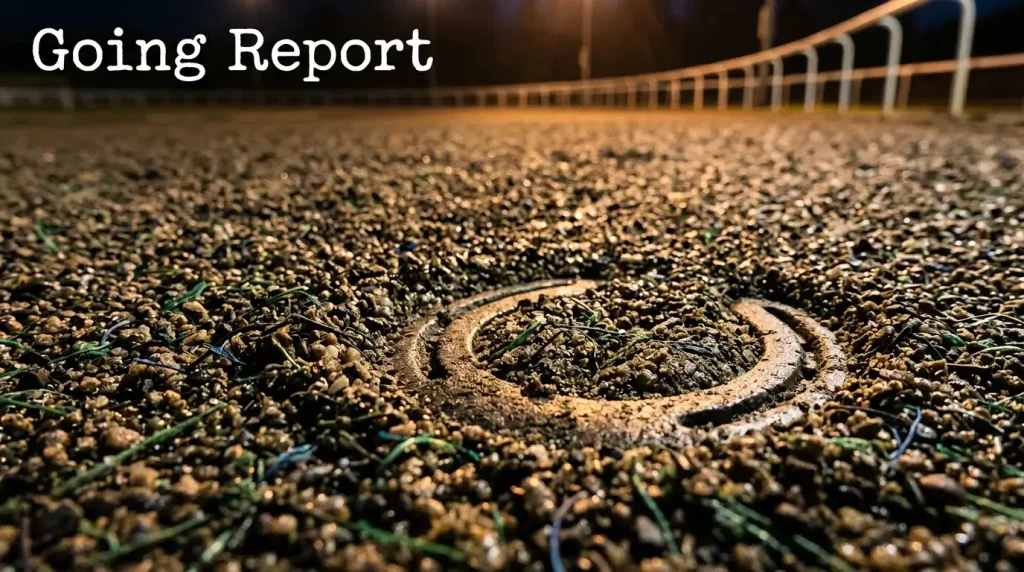
Wolverhampton became the first track in Britain to install Tapeta in 2014, replacing the previous Polytrack surface. Tapeta is a blend of wax-coated sand, synthetic fibres and recycled rubber, designed to drain efficiently and maintain a uniform consistency. The wax coating is the critical component: it prevents the sand from compacting under traffic, which means the surface recovers between races in a way that turf physically cannot. After a seven-race evening card, the Tapeta at Wolverhampton is in essentially the same condition for the seventh race as it was for the first. On turf, the ground would be measurably different by the final race — cut up, softer in places, inconsistent underfoot.
The clerk of the course at Wolverhampton determines the official going using a combination of the going stick — a mechanical instrument that measures surface resistance — and visual assessment. The going stick provides a numerical reading that maps to the descriptive scale. Because Tapeta’s properties are engineered rather than natural, the readings are more consistent than on turf, and the clerk’s assessment tends to confirm what the data shows: standard, with occasional marginal variation.
That consistency is precisely why the going at Wolverhampton carries less analytical weight than it does at turf courses. You do not need to study the going forecast for a week in advance or worry about overnight rain reshaping the race. But “less weight” is not “no weight” — the marginal differences between standard and standard to slow do affect outcomes, and ignoring them entirely means missing a detail that sharper operators will catch.
How the Going Affects Race Results at Wolverhampton
The shift from standard to standard to slow at Wolverhampton is not dramatic, but it is measurable. On a standard-to-slow surface, finishing times tend to be fractionally slower — between half a second and a full second over a mile, depending on the pace scenario. That sounds trivial, and in isolation it is. But the effect compounds when combined with other variables: pace, draw and running style.
Front-runners feel the difference first. On a slightly slower surface, the kickback from the Tapeta is heavier, and the energy cost of leading rises marginally. A front-runner that makes all on standard going might tire a half-furlong earlier on standard to slow, opening the door for a closer who was always going to finish strongly. At 5f, where the margin between leading and being caught is already razor-thin, that half-furlong matters. At 1m4f, the effect is diluted by the longer distance and the greater tactical flexibility available to riders.
Hold-up horses benefit slightly when the surface rides slow. They conserve energy in the early stages, face less severe kickback from behind the leaders, and find the ground marginally more forgiving when they launch their challenge in the closing stages. This does not overturn the structural advantages of front-running at sprint distances — the draw and pace biases still hold — but it nudges the balance a fraction.
The surface’s physical properties also play into safety. Research by Dr. Pratt of Tapeta Footings found that horses on Tapeta experience roughly 50% less concussion impact compared with other surfaces. That reduced impact is partly why the going remains consistent: the surface absorbs shock without breaking down, which means the footing at the start of a meeting is virtually identical to the footing at the end. For punters, this translates into a simple principle — form on Tapeta is more reliable from one run to the next than form on turf, because the variable of ground conditions has been largely removed from the equation.
Draw bias at Wolverhampton is not meaningfully affected by the going. Whether the surface is standard or standard to slow, the tight left-handed bends still favour low draws at sprint distances. The geometry of the track does not change with the surface reading; what changes is the small tactical balance between pace styles. If you are already filtering by draw, the going is a secondary consideration — worth a glance, rarely worth a change of plan.
Where to Check the Going Before a Meeting
The official going at Wolverhampton is published by the clerk of the course no later than 45 minutes before the first race. For evening fixtures, that typically means a going announcement by 15:45 or 16:15, depending on the first-race time. The announcement appears on the Wolverhampton Racecourse website and is distributed simultaneously through the BHA’s official data feeds to all licensed bookmakers and racing media.
Racing Post and Sporting Life both display the going on their racecard pages, updated in real time once the official announcement is made. If you use either platform for pre-race analysis, the going will be visible alongside the runners and riders without needing to visit a separate page.
Social media can sometimes provide an earlier indication. The Wolverhampton Racecourse account on X occasionally posts going updates ahead of the official declaration, and on-course reporters for Racing TV and ITV Racing may comment on surface conditions during their preview coverage. These are informal signals rather than official data, but they can give you a head start if you are planning to place early-price bets before the going is formally confirmed.
At Wolverhampton, the going check is the quickest part of your pre-race routine. Confirm it is standard or standard to slow, note any marginal shift from the previous meeting, and move on to the factors that carry more weight at this track: draw, pace and connections. The going is part of the picture, but at Dunstall Park it is a very small part — and treating it as anything more than that is energy better spent elsewhere.