
Wolverhampton Course Guide — Track Layout and Key Distances
Best Horse Racing Betting Sites – Bet on Horse Racing in 2026
Loading...
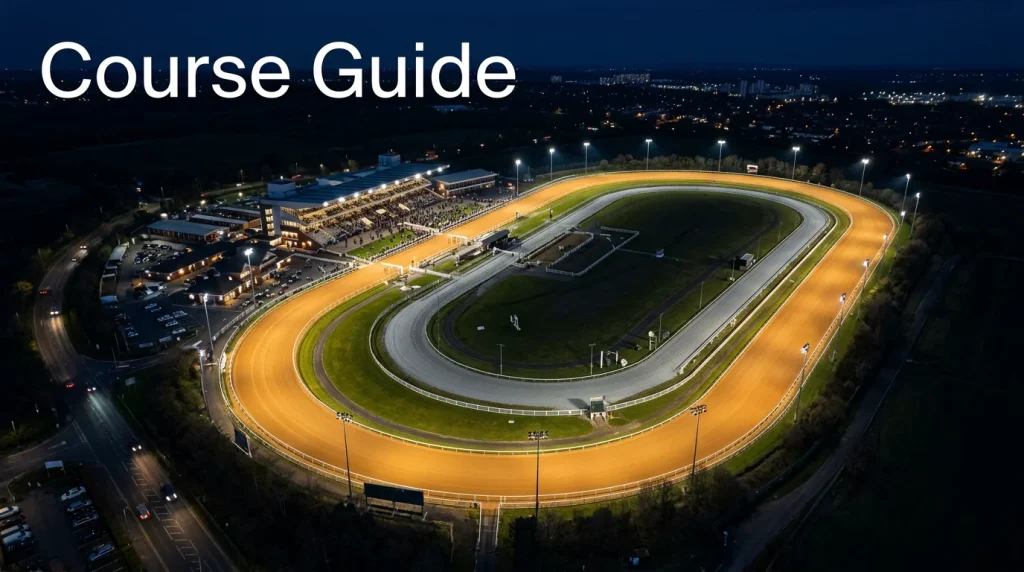
The Wolverhampton course guide starts with a simple fact: Dunstall Park is a left-handed oval with a circumference of approximately one mile, surfaced with Tapeta and lit by floodlights. Every race staged here — from a 5f sprint to a 1m6f staying test — runs on that same oval, but the starting positions, the angle of approach to the bends and the length of the home straight change with the distance. Understanding how the track shapes each race is the foundation on which draw bias, pace analysis and tactical assessment are built.
This guide walks you around the circuit bend by bend, explains where each distance starts and finishes, and describes how the track’s geometry creates the biases that make Wolverhampton different from every other all-weather venue in Britain. If you have ever wondered why low draws dominate at 5f, why stall 9 is catastrophic at 7f, or why the home straight feels so short at Dunstall Park, the answers are in the layout itself.
Track Geometry — Shape, Surface and Bends
Wolverhampton’s oval is not a perfect circle. The bends are tighter than at most comparable tracks — noticeably sharper than the sweeping curves at Newcastle or the gradual turns at Kempton. That tightness is the single most important feature of the course, because it compresses the field on every bend and penalises horses who race wide. The inside rail is the shortest path, and the further you are from it, the more ground you lose. Over two bends in a 7f race, the difference between the rail and three wide can amount to several lengths — a gap that does not appear in the result but is visible in the replay and measurable in the data.
The track has been surfaced with Tapeta since 2014, when Wolverhampton became the first British course to install the material. Tapeta is a composite of wax-coated sand, synthetic fibres and recycled rubber, designed to provide consistent footing and efficient drainage. The going is almost always described as standard, and the surface recovers between races far more effectively than turf, which means the conditions at the start of a seven-race card are virtually identical to the conditions at the end.
The home straight at Wolverhampton runs for approximately two furlongs from the final bend to the winning post. That is short by flat-racing standards — Newmarket’s straight course is twice as long — and it means that any horse still behind the leaders turning for home has limited time to make up ground. The short straight favours front-runners and prominent racers, particularly at sprint distances where the time spent in the straight represents a larger proportion of the total race.
The camber of the bends tilts inward, assisting horses on the rail but adding a slight centrifugal challenge for those racing wide. Jockeys who ride regularly at Wolverhampton understand how to manage this camber — angling their horse into the turn, maintaining impulsion without fighting the bend. First-time visitors, whether human or equine, can lose ground simply by not knowing the rhythm of the track.
There are no undulations of any significance. The course is flat, which means stamina is tested purely by distance and pace rather than by the gradient. This is another distinction from turf courses, where uphill finishes and downhill bends add complexity. At Wolverhampton, the variables are surface, geometry and tactics — nothing else.
Distance-by-Distance Walkthrough
Each distance at Wolverhampton has a different starting position, a different relationship to the bends, and a different tactical profile. Here is what you need to know about each one.
Five furlongs is the shortest trip and the one where the track’s geometry has the greatest impact. The start is from a chute on the far side of the course, and the field faces an almost immediate left-handed bend. Horses drawn low — stalls one through four — have the inside line into that bend and can establish position without losing ground. Horses drawn high must either use extra energy to cross over or accept a wider path. In fields of ten or more, this positional disadvantage is severe enough to show up as a measurable loss in level-stakes profit over five seasons. Front-runners dominate at this distance, and the combination of low draw plus early pace is the most profitable angle on the entire course.
Six furlongs starts further back along the same chute, giving the field slightly more time before the first bend. The draw bias remains significant but is marginally less extreme than at 5f, because the extra furlong allows wider-drawn horses a few more strides to find position. Stall 5 at 6f has been the most profitable position over five years of handicap data. The pace dynamic is similar to 5f — front-runners still hold an advantage — but the slightly longer distance means closers have a fraction more time to make their challenge in the home straight.
Seven furlongs and the Lady Wulfruna distance of 7f 36y start from a position that sends the field into the first bend at a different angle. The draw bias at 7f shifts: the middle stalls tend to be more favourable, and the extreme high draws become significantly worse. Stall 9 at 7f is the most unprofitable position at any distance on the course. The race unfolds with less urgency than a sprint — the pace is typically strong but not frantic — and horses who settle in midfield before making a challenge approaching the home turn have a better chance than at the shorter distances.
One mile starts on the round section of the oval, and the field negotiates both bends at a point in the race where they are still settling into stride. The draw bias at 1m is less pronounced because the first bend arrives when the field is still bunched and the leaders have not yet established a decisive advantage. Tactical speed — the ability to hold a position without using extra energy — matters more than raw gate speed.
One mile one furlong and one mile four furlongs extend the trip beyond a single lap. At these distances, the draw is close to irrelevant, the pace is dictated by the riders rather than the geometry, and the result is determined primarily by ability, fitness and tactical execution. Hold-up horses compete on more equal terms here, and the front-runner bias that defines the sprints fades to statistical noise.
One mile six furlongs is the longest distance staged at Wolverhampton and is relatively rare on the fixture card. It tests stamina on a flat, left-handed track where there is no uphill finish to help separate the stayers from the plodders. The draw is immaterial, and the result is almost entirely a function of the pace scenario and the horses’ stamina reserves.
Under the Floodlights — Night Racing at Dunstall Park
Wolverhampton was the first racecourse in Britain to stage racing under floodlights, beginning in 1993, and evening meetings remain the defining feature of its schedule. The majority of Dunstall Park fixtures — particularly during the winter all-weather season — are evening cards, with the first race typically going off between 16:30 and 18:00 and the last by 20:30 or 21:00.
The floodlights create an atmosphere that is distinct from daytime racing. The track glows against the dark West Midlands sky, the stands feel more enclosed, and the crowd — while smaller in absolute terms than a major Saturday turf fixture — is concentrated and audible. Wolverhampton draws around 120,000 visitors per year across all events, and a significant share of that figure comes through the gates for evening racing. David Ideson, the racecourse’s executive director, has described the ongoing investment at Dunstall Park as transforming the venue into a true destination for corporate and consumer events — and the floodlit evening card is central to that identity.
For punters, evening meetings carry a few quirks worth noting. The on-course betting ring is typically smaller than at major daytime fixtures, which can make the starting price less representative of the broader market. Betting exchange liquidity is also lower, particularly for races that go off after 20:00. Both factors can mean wider price fluctuations and greater discrepancies between fixed-odds and exchange prices — an environment where attentive bettors can sometimes find value that the thinner market has not corrected.
The surface itself is not affected by the time of day. Tapeta rides the same under floodlights as it does in daylight, and the going description does not change between afternoon and evening. What changes is the temperature: winter evenings are colder, and a drop in temperature can fractionally affect how the wax component of the Tapeta behaves. The effect is minor and is already factored into the going description by the clerk of the course, but it is one more detail in the picture — and at a track where the margins are measurable, details add up.