
Wolverhampton Tapeta Surface — How It Shapes Race Results
Best Horse Racing Betting Sites – Bet on Horse Racing in 2026
Loading...
The Ground Beneath the Hooves
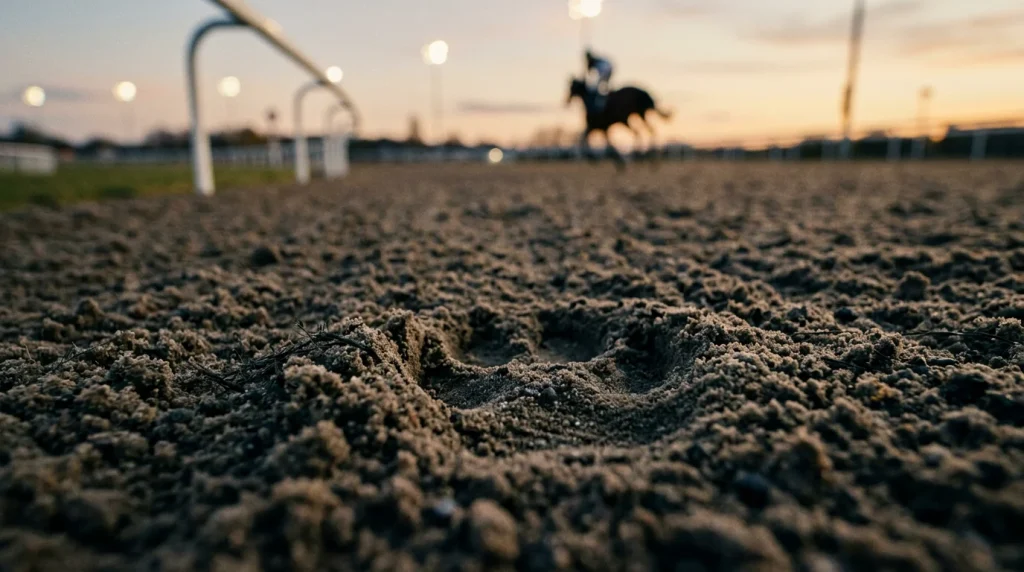
Wolverhampton’s all-weather track surface determines more about race results at Dunstall Park than any other single factor — more than the draw, more than the jockey booking, more than the official going report. Since 2014, that surface has been Tapeta, a proprietary blend of wax-coated sand, synthetic fibres, and recycled rubber that was engineered to do one thing above all else: behave the same way in January as it does in July. Wolverhampton was the first racecourse in Britain to install Tapeta, and its decade-long tenure on the surface remains the longest of any track in the country.
That distinction matters for anyone trying to interpret form. A horse with three wins on Polytrack at Lingfield is not necessarily a horse with three wins on a similar surface. Polytrack and Tapeta share a synthetic label but differ in composition, in drainage, in the way they absorb and return energy through the hoof. Horses that excel on one can struggle on the other. Trainers who understand the difference exploit it. Bettors who do not understand it donate to those who do.
This article traces the full surface history at Wolverhampton — from the Fibresand era that began in 1993 through the Polytrack years and into the current Tapeta installation. It examines what Tapeta is made of, how it behaves under different conditions, and what the global equine injury data says about its safety record. It then turns to the practical question that matters most to anyone studying a racecard: how to read form on Tapeta, which horses handle it well, and which surface transfers are reliable. The ground beneath the hooves shapes everything that happens above it.
From Fibresand to Tapeta — A Surface Timeline
Wolverhampton’s all-weather journey began on 26 December 1993, when the track staged Britain’s first-ever all-weather flat meeting on Fibresand. The surface was revolutionary for its time: a mix of silica sand and synthetic fibres that allowed racing to continue through the winter months, when turf tracks were waterlogged or frozen. Before Fibresand, the flat season in Britain effectively shut down from November to March. Wolverhampton changed that, and the venue quickly became the go-to track for winter racing under its newly installed floodlights — another first for British horse racing.
Fibresand served its purpose but had limitations. The surface was abrasive, particularly on the joints of horses that raced on it regularly. Times were slower than on turf, and the kickback — the spray of material thrown up by leading horses — was a persistent complaint from jockeys and trainers. By the early 2000s, the racing industry had moved on. Polytrack, developed by Martin Collins Enterprises, offered a softer ride and better drainage. Wolverhampton switched to Polytrack in 2004, joining Lingfield and Great Leighs (now Chelmsford) on the same synthetic family.
The Polytrack decade was productive. Field sizes improved, the injury rate dropped compared to Fibresand, and the track’s reputation among trainers recovered. But Polytrack had its own quirks. The surface changed character over time as the wax binder degraded, and maintenance requirements were demanding. When Michael Dickinson, the former champion jumps trainer turned surface engineer, offered his Tapeta product to the British market, Wolverhampton was the first to commit.
The Tapeta installation went down in late 2014, and the first races on the new surface were staged in early 2015. The transition was not seamless — any surface change resets the form book, and trainers needed time to learn how their horses performed on the new material. Within two seasons, though, the data stabilised. Wolverhampton on Tapeta produced faster times than Wolverhampton on Polytrack, fewer cancellations due to surface degradation, and a safety record that the track’s management has highlighted consistently since. The chronology — 1993 Fibresand, 2004 Polytrack, 2014 Tapeta — is more than trivia. Each surface change altered which horses won, which running styles thrived, and which form lines could be trusted. Historical results from the Fibresand era are functionally irrelevant to today’s racing. Polytrack-era form is a better guide, but still imperfect. Only Tapeta form at Wolverhampton, from 2015 onwards, is directly comparable to what the track produces now.
What Tapeta Is Made Of and How It Works
Tapeta is a three-component surface. The base layer is silica sand, graded to a specific particle size that provides structural support and drainage. Mixed into the sand are synthetic fibres — short strands of polypropylene that bind the material together and prevent it from compacting under repeated use. The third ingredient is recycled rubber granulate, sourced from processed tyres, which adds cushion and elasticity. The entire blend is coated in a proprietary wax that waterproofs the individual grains and controls how moisture moves through the profile.
The wax coating is what separates Tapeta from earlier synthetic surfaces. On Fibresand, water sat on top of the material and made the surface heavy when it rained. On Polytrack, the binder degraded over time and required regular top-ups to maintain consistency. Tapeta’s wax layer repels water downward through the profile, where a drainage membrane channels it away from the racing surface. The result is a track that rides the same whether it has rained for three days or not rained for three weeks. The official going description at Wolverhampton is almost always “standard” or “standard to slow” — a reflection not of laziness in reporting but of a surface that genuinely does not change much.
Underneath the Tapeta layer sits a porous sub-base, typically crushed stone, that supports the surface and provides a secondary drainage path. The total depth of the racing surface is around fifteen centimetres — deep enough to absorb the concussive force of a galloping horse, shallow enough to return energy efficiently and maintain speed. The balance between cushion and firmness is the core engineering challenge, and Dickinson’s design leans slightly toward the cushioned end. Horses on Tapeta tend to experience less jarring through the fetlock and knee joints than on Polytrack, though the difference is subtle and varies with maintenance cycles.
Maintenance is constant. The surface is harrowed between races to redistribute the material and prevent the formation of a hard pan beneath the top layer. Watering is controlled by an automated irrigation system that monitors moisture levels across the track. The wax coating means less water is needed than on Polytrack, which reduces both cost and the risk of over-watering — a common cause of inconsistent going on other synthetic tracks. The overall effect is a surface that requires attention but rewards it with predictability, which is precisely the quality that trainers and bettors value most.
Safety on Synthetic Surfaces — What the Injury Data Shows
The strongest argument for synthetic surfaces has always been safety, and the data supports it convincingly. The US Jockey Club’s Equine Injury Database — the most comprehensive longitudinal dataset on racehorse fatalities — reported that in 2022, synthetic surfaces recorded a fatality rate of 0.41 per 1,000 starts. That same year, dirt tracks recorded 1.44 per 1,000 and turf tracks 0.99 per 1,000. Synthetic surfaces were roughly three and a half times safer than dirt and two and a half times safer than turf.
The 2023 data introduced some nuance. The synthetic fatality rate rose to 0.97 per 1,000 starts — a significant increase, though it remained the lowest of any surface type that year, with dirt at 1.43 and turf at 1.13. The jump was driven partly by smaller sample sizes on synthetic tracks in the US and partly by year-to-year statistical noise. A single additional fatality on a track that hosts relatively few starts can move the rate substantially. The long-term trend, across more than a decade of data, still favours synthetic surfaces by a wide margin.
Professor Tim Parkin of the University of Bristol, who analyses the EID data, provided broader context when the 2022 figures were published: “The data shows that since 2009, the risk of fatal injury during racing has declined by 37.5%, which is statistically significant.” That decline spans all surface types, but synthetic tracks have consistently anchored the low end of the range. The improvement reflects better veterinary screening, improved track maintenance, and the expansion of synthetic racing — but the surface itself is a fundamental driver. Softer footing means less concussive impact per stride, which means fewer catastrophic breakdowns of bone and tendon under stress.
The most striking individual case study comes from Gulfstream Park in Florida. Gulfstream installed Tapeta specifically alongside its existing dirt track, which allowed a direct comparison at the same venue, with the same horse population, under the same climate. Over the 2022–2023 period, the Tapeta track recorded just one fatality in 7,085 starts — a rate of 0.14 per 1,000. The dirt track at the same facility ran at several multiples of that figure. Bill Casner, the racing executive who compiled the analysis, described the difference as unambiguous: same horses, same trainers, same management, different surface, vastly different outcomes.
Research by Dr. Mick Pratt of Tapeta Footings has added a biomechanical dimension. His studies measured the concussive force transmitted through the hoof on different surfaces and found that horses on Tapeta experience roughly 50% less impact than on conventional footing. That reduction does not eliminate risk — catastrophic injuries still occur on any surface — but it lowers the cumulative stress on the musculoskeletal system, which may explain why fatality rates on Tapeta tracks tend to cluster at the very bottom of the synthetic range.
For the British context, the implications are clear. Wolverhampton races year-round, hosting more than eighty fixtures per season, with many horses appearing repeatedly at the track. Cumulative hoof impact matters more when a horse runs ten times a year at the same venue than when it visits once. A surface that reduces concussive load by half is not just a safety feature — it is a structural advantage for the horse population that races there regularly, and a factor that trainers increasingly cite when choosing where to campaign their all-weather strings.
Tapeta vs Polytrack — How the Two Surfaces Compare
Three of Britain’s six all-weather tracks run on Polytrack: Lingfield, Kempton, and Chelmsford. The other three — Wolverhampton (since 2014), Newcastle (since 2016), and Southwell (which switched from Fibresand to Tapeta in 2021) — all race on Tapeta. The practical consequence for form students is that cross-surface transfers — horses moving from a Polytrack track to a Tapeta venue, or vice versa — need to be assessed with more care than moves between two tracks on the same surface.
The surfaces differ in composition and behaviour. Polytrack uses a blend of recycled fibre, rubber, and sand bound with a wax coating, similar to Tapeta in concept but different in proportion and in the engineering of the wax layer. Polytrack tends to ride slightly firmer than Tapeta, particularly in dry conditions, because its wax binder sits more on the surface rather than penetrating through the grain. Horses on Polytrack report (through race times and stride data) a marginally quicker initial footfall and a slightly harder rebound, which suits horses with a sharp, efficient action. Tapeta, by contrast, absorbs more energy on impact and returns it more gradually, which favours horses with a longer, more fluid stride pattern.
Kickback is another point of divergence. Polytrack produces notable kickback in large fields — the material sprays up behind the leading group and can affect horses racing in behind. Tapeta generates less kickback, partly because the wax coating keeps the grains heavier and less prone to becoming airborne. This matters for running style. Hold-up horses on Polytrack can be put off by the material hitting them in the face at forty miles per hour. On Tapeta, the same horses run more comfortably in behind, which may explain why closers fare slightly better at Wolverhampton than the draw bias alone would suggest.
Drainage performance differs too. Both surfaces are designed to handle rain, but Tapeta’s through-profile wax coating means water moves vertically through the material rather than pooling on top. Polytrack can become tacky in sustained rain before the drainage catches up, which temporarily changes the going. At Wolverhampton, the going report rarely shifts from “standard” to “standard to slow,” and the change, when it happens, is subtle. At Polytrack venues, the range of going descriptions is wider, and a horse’s performance can vary more with conditions.
What does this mean for form transfers? Horses with strong Polytrack form are not automatically suited to Tapeta, but they are better placed than horses transferring from turf. The synthetic-to-synthetic transition is more reliable than the turf-to-synthetic transition, because the underlying biomechanics — a more cushioned footfall, reduced concussive impact, less variable footing — are shared. Within that, the best transfers tend to come from horses that have shown they handle a slightly deeper, more energy-absorbing surface. Horses that need firm ground to show their best on Polytrack may find Tapeta just a fraction too demanding. Horses that have struggled on the quickest Polytrack surfaces — Chelmsford in dry weather, for example — sometimes improve at Wolverhampton, where the extra give in the surface suits their action.
Reading Form on Tapeta — What to Look For
Assessing whether a horse will handle Tapeta begins with the simplest question: has it run on Tapeta before? Wolverhampton is the longest-established Tapeta track in Britain, so previous form at the venue is the most direct indicator. A horse with two or more runs at Wolverhampton and consistent finishing positions is a horse that handles the surface. A horse that has run at Wolverhampton once and finished tailed off may not — though a single poor run could also reflect the draw, the trip, or the pace rather than a surface aversion.
When there is no Wolverhampton form to work with, the next step is to examine Polytrack form. As noted, the synthetic-to-synthetic transition is more reliable than turf-to-synthetic, and horses with solid all-weather records at Lingfield, Kempton, or Chelmsford transfer to Tapeta successfully more often than not. The exception is the horse that needs fast, firm Polytrack and cannot cope with the slightly deeper Tapeta footprint. These horses tend to show a pattern: strong at Chelmsford on quick going, weaker at Kempton when the track is on the slow side. If that pattern exists, Wolverhampton is likely to replicate the weaker end of it.
Sire data offers a secondary filter. Certain stallion lines produce offspring that thrive on synthetic surfaces across the board — these are typically sires whose progeny show a preference for easy ground on turf, a low, efficient action, and a tolerance for deep footing. Stallions whose stock want fast turf and struggle on soft going tend to produce fewer synthetic specialists. The correlation is not absolute, but it is strong enough to be useful when assessing a first-time all-weather runner. Sire statistics by surface are published by several commercial form providers, and the data for Tapeta specifically — filtered to Wolverhampton results from 2015 onwards — is available from platforms that track all-weather performance.
Running style interacts with the surface in ways that show up in the data. Tapeta’s cushioned profile absorbs more energy per stride than Polytrack, which means front-runners burn fractionally more fuel over the course of a race. At sprints, the cost is minimal and the positional advantage of leading outweighs it. At middle distances, the energy cost becomes more significant, and horses that race prominently but not on the lead — tracking the pace two or three lengths off — tend to have a better completion rate than outright leaders. Hold-up horses perform more consistently on Tapeta than on Polytrack, partly because the reduced kickback lets them settle, and partly because the surface does not favour raw speed as aggressively as a firm Polytrack surface does.
The biomechanical data on concussive impact — covered in the safety section above — has a practical form implication. Horses recovering from joint or tendon issues, or older horses whose musculoskeletal systems have accumulated wear, tend to run better on Tapeta than their recent turf form suggests. Trainers who specialise in rehabilitating horses often target Wolverhampton for their first runs back, and the results bear out the logic. A horse returning from a layoff with joint problems, running at a venue that demonstrably reduces skeletal stress, has a genuine physical advantage — and the market does not always price it in.
Tapeta Goes Global — From Wolverhampton to Belmont Park
When Wolverhampton installed Tapeta in 2014, it was a single track in the West Midlands taking a bet on an unproven surface. A decade later, that bet looks prescient. Tapeta has expanded across four continents, and the highest-profile adoption is happening not in Britain but in New York.
The New York Racing Association announced in 2026 that winter racing at Belmont Park will be conducted entirely on Tapeta from 2026. The new facility — a purpose-built one-mile oval within the redeveloped Belmont complex — represents the most significant commitment to Tapeta by a major North American racing jurisdiction. NYRA’s decision was driven explicitly by safety data. Dave O’Rourke, NYRA’s President and CEO, stated that the relevant data unequivocally supported a shift to all-weather surfaces during the colder months, when dirt tracks freeze and thaw unpredictably, creating conditions that elevate injury risk.
Belmont is not an isolated case. Woodbine in Toronto switched from Polytrack to Tapeta in 2016, making it one of the longest-running Tapeta installations in North America. Golden Gate Fields in California used Tapeta before its closure in June 2026. Gulfstream Park in Florida installed a Tapeta training track alongside its existing dirt surface, producing the safety data that helped build the case for wider adoption. In Japan, several training centres use Tapeta-derived surfaces for conditioning work, though JRA racecourses have not yet adopted it for competitive racing. The global trend is clear: jurisdictions that prioritise equine welfare metrics are moving toward Tapeta or Tapeta-adjacent products.
For the British racing landscape, Wolverhampton’s position as the longest-established Tapeta venue — joined by Newcastle (2016) and Southwell (2021) — creates both advantages and considerations. The advantage is specialisation: horses that love the surface have three venues to target, with Wolverhampton offering the longest fixture list of any Tapeta track in Britain, which builds a specialist population at Dunstall Park and creates opportunities for bettors who can identify surface preferences. The consideration is that Tapeta-to-Polytrack form transfers still require careful assessment, since Polytrack venues make up half of the British all-weather circuit.
Whether other British tracks follow Wolverhampton’s lead depends on economics as much as safety. Tapeta installations are expensive — the surface, the sub-base, the drainage system, and the ongoing maintenance represent a significant capital outlay. Arena Racing Company, which owns Wolverhampton, invested £10 million in the venue’s overall infrastructure, of which the surface is a component. For tracks with tighter margins, the cost may be prohibitive even if the safety case is compelling. But if Belmont’s Tapeta experiment succeeds — and early indicators from Gulfstream suggest it will — the pressure on other jurisdictions, including Britain, to diversify away from a Polytrack monoculture will grow. Wolverhampton, the first Tapeta track in the country and still the one with the longest continuous service record on the surface, may find its pioneering status validated rather than diminished.